
Doctor Hopping And The Search For Healing…
Why So Many People Fail in Their Search to Heal From Mold Illness
Yesterday, I saw a patient who reminded me exactly why so many people remain stuck in mold illness for years.
His exposure was unusual but significant: he had been drinking from a mold-contaminated water bottle for years.
When he first came to me, he could barely function.
We started binders and a targeted nasal spray, and he improved.
But over the past four years, I have only seen him three times.
He takes the binder for a while.
He feels better.
Then he stops.
Months later, symptoms start creeping back in, so he picks it up again for a little while.
He still gets headaches from time to time.
And here is the frustrating part:
This is someone who already proved that the treatment works.
Before adding binders and a nasal spray, he was barely functioning. Once we started reducing the toxin burden and treating the nasal colonization, his life improved dramatically.
But improvement is not the same thing as completing treatment.
That is where so many people get stuck.
Mold Illness Is Not Usually an Instant-Fix Illness
I wish there were one pill, one IV, one supplement, or one magical protocol that made mold illness disappear overnight.
There is not.
Healing from mold illness usually requires a period of consistency and dedication.
You have to follow the steps long enough to actually clean the tank, calm the inflammation, restore the systems that were disrupted, and allow the body to recover.
Feeling better after a few weeks does not necessarily mean the work is finished.
It may simply mean that the treatment is working.
Stopping every time symptoms improve often creates a cycle:
You feel terrible.
You restart treatment.
You improve.
You stop.
Symptoms return.
Then you repeat the process.
That is not treatment failure.
That is incomplete treatment.
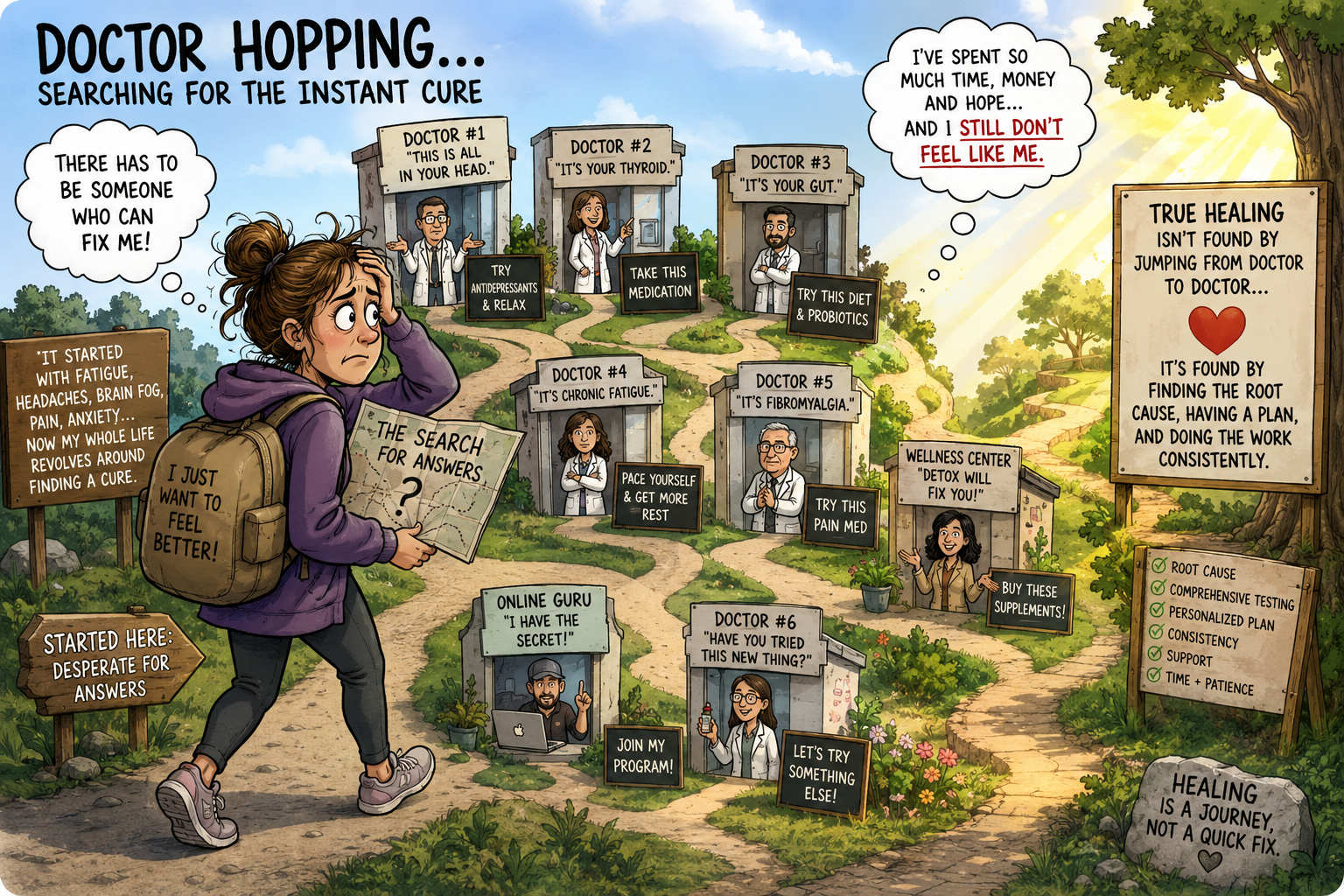
The Doctor-Hopping Trap
I see this constantly in mold illness Facebook groups.
Patients jump from doctor to doctor looking for the person who has the secret cure.
They try one binder for two weeks.
Then a different spray.
Then a new supplement stack.
Then a new detox protocol.
Then another practitioner promises a faster way.
Meanwhile, no one has had enough time to follow the full story, track the response, repeat the appropriate testing, or adjust the treatment based on how the body is changing.
Mold illness is rarely solved through random, piecemeal care.
It requires a plan.
It requires follow-up.
It requires someone who is willing to look at the whole person and adjust the plan as new information emerges.
You Cannot Treat Mold in Isolation
Mold does not politely affect one organ system.
It can disrupt the immune system, brain, nervous system, hormones, thyroid, metabolism, gut, sleep, circulation, and detoxification pathways.
That means the treatment plan has to be comprehensive.
Sometimes the first priority is restoring thyroid function because the patient has no energy, cannot regulate body temperature, and cannot mobilize toxins effectively.
Sometimes we have to balance hormones because Grace may not survive treatment without killing her husband first.
Sometimes we begin with aggressive mold detoxification and add other support as symptoms surface.
Sometimes we open one Pandora’s box and discover three more.
We may need to address:
Chronic inflammation
Thyroid dysfunction
Hormonal imbalance
Mitochondrial dysfunction
Nutrient deficiencies
Gut permeability
Nasal or sinus colonization
Nervous system dysregulation
Lyme disease and co-infections
Ongoing environmental exposure
There is no single universal mold protocol because there is no single universal mold patient.
The Environment Still Matters
You cannot out-supplement an ongoing exposure.
You cannot bind toxins all day and then sleep eight hours every night in a contaminated building.
You cannot fully recover while carrying every porous item from a heavily contaminated environment into your new space.
Environmental investigation and avoidance are often some of the hardest parts of treatment, but they are also some of the most important.
If the tank keeps being refilled, we cannot finish cleaning it.
Follow-Up Is Part of the Treatment
Follow-up visits are not just a formality.
They are where we determine:
Whether the binder is working
Whether the dose is adequate
Whether constipation or poor drainage is slowing progress
Whether the nasal treatment needs to change
Whether inflammatory markers are improving
Whether hormones or thyroid function need support
Whether another infection or exposure is blocking recovery
Whether it is time to advance, pause, or modify the plan
Mold treatment is dynamic.
What your body needs at the beginning may be very different from what it needs six months later.
That is why seeing a physician once every year or two and restarting the same binder whenever symptoms flare is rarely enough to finish the job.
The Good News
People do heal from mold illness.
I see it all the time.
They stop reacting to every building.
Their headaches improve.
Their brains come back online.
Their energy returns.
Their hormones stabilize.
Their nervous systems calm down.
They go back to work, travel, exercise, socialize, and live without mold controlling every decision.
But the patients who get there usually have one thing in common:
They follow the program.
Not perfectly.
Not without setbacks.
But consistently enough, and long enough, to allow the body to complete the work.
Healing from mold illness is not about being trapped in treatment forever.
The goal is to do the work for a season so you can go back to living.
The binder is not your life.
The nasal spray is not your identity.
The appointments are not the destination.
They are the road out.
If you have been circling the same symptoms for years, it may not mean that you are impossible to heal.
It may mean that your treatment has been fragmented, inconsistent, or stopped before the body was truly finished.
Mold illness is complicated.
But it is treatable.
And when the right plan is followed with consistency, mold no longer gets to be in charge of your life.
Could Mold Be Part of Your Story?
A Self-Screening Guide for People Looking for Answers
Have You Been Told "Everything Looks Normal"?
Do you feel like something is wrong with your health...
...but every lab comes back "normal"?
Have you been told it's:
Anxiety
Stress
Depression
Getting older
Hormones
"Just IBS"
Fibromyalgia
Chronic fatigue
While all of those diagnoses can certainly be real, there is another piece of the puzzle that is frequently overlooked:
Environmental mold exposure.
Not everyone exposed to mold becomes sick. But for some people, exposure to water-damaged buildings or mold-contaminated environments can contribute to chronic inflammation and symptoms affecting nearly every organ system.
This guide is not a diagnostic test. Instead, it is designed to help you decide whether mold exposure is something worth discussing with your healthcare provider.
Step 1: Have You Been Exposed?
Think about your lifetime—not just where you live now.
Check any that apply:
□ Basement flooding
□ Roof leak
□ Plumbing leak
□ Water under flooring
□ Musty smells
□ Visible mold
□ Condensation on windows
□ HVAC problems
□ Crawl space moisture
□ Bathroom mold
□ Apartment with water damage
□ College dorm
□ Military barracks
□ School or workplace with leaks
□ Flooded office
□ Water-damaged vehicle
□ Moldy CPAP equipment
□ Moldy water bottle or humidifier
□ Frequent camping or cabins with moisture
□ Childhood home with flooding
Even if the leak was repaired, mold toxins may remain.
Step 2: Do Your Symptoms Fit?
Check every symptom you experience regularly.
Brain
□ Brain fog
□ Difficulty concentrating
□ Memory problems
□ Word-finding difficulty
□ Feeling "drunk" without alcohol
□ Anxiety that seemed to appear out of nowhere
□ Depression that doesn't respond well to treatment
□ Irritability
□ Panic attacks
Energy
□ Fatigue
□ Waking unrefreshed
□ Need naps
□ Exercise intolerance
□ Crash after activity
Head
□ Headaches
□ Migraines
□ Dizziness
□ Motion sensitivity
□ Visual changes
Sinuses
□ Chronic congestion
□ Postnasal drip
□ Sinus infections
□ Yellow drainage
□ Constant throat clearing
Lungs
□ Shortness of breath
□ Asthma
□ Chronic cough
□ Air hunger
Gut
□ Bloating
□ IBS
□ Food sensitivities
□ Constipation
□ Diarrhea
□ Reflux
Skin
□ Itching
□ Hives
□ Eczema
□ Acne
Hormones
□ Weight gain
□ Weight loss
□ Low testosterone
□ Low libido
□ Irregular periods
□ Hot flashes
Muscles & Joints
□ Muscle aches
□ Joint pain
□ Morning stiffness
Nervous System
□ Tingling
□ Internal vibrations
□ Temperature intolerance
□ Racing heart
□ Blood pressure fluctuations
□ Feeling "wired but tired"
Step 3: Do Your Symptoms Change With Buildings?
Do you notice that you:
□ Feel better on vacation?
□ Feel worse at work?
□ Feel worse at home?
□ Feel worse after visiting certain buildings?
□ Feel better outside?
□ React to musty smells?
□ Feel worse after rainstorms?
These clues can sometimes point toward an environmental trigger.
Step 4: Try the Visual Contrast Sensitivity (VCS) Test
One of the easiest screening tools available is the Visual Contrast Sensitivity (VCS) Test.
This online screening evaluates how well your eyes detect subtle differences in contrast. In some people with biotoxin exposure or other inflammatory illnesses, contrast sensitivity may be reduced.
You can take the screening test here:
A failed VCS test does not diagnose mold illness, but it may indicate that additional evaluation is warranted, especially when combined with compatible symptoms and exposure history.
Step 5: Ask Yourself These Questions
Did my illness begin after moving into a new home?
Did symptoms start after a water leak?
Do I feel better when I'm away from home?
Has no one been able to explain why I feel this way?
Have I accumulated multiple diagnoses instead of one explanation?
Have treatments only partially helped?
If you answered "yes" to several of these, environmental illness deserves consideration as part of your medical evaluation.
Common Misconceptions
"My house is new."
New homes can still develop mold if moisture becomes trapped during construction or after leaks.
"I don't see mold."
Most mold grows behind walls, under flooring, inside HVAC systems, or in crawl spaces.
"My allergy test was negative."
Mold illness is not always an allergy. Some people experience inflammatory responses to mold toxins rather than classic allergic reactions.
"I already moved."
Symptoms can persist even after leaving an exposure, especially if inflammation remains active or belongings continue to carry mold particles.
What Should You Do Next?
If mold seems like it could be part of your story:
• Discuss your symptoms with your healthcare provider.
• Consider environmental assessment of any suspected water-damaged buildings.
• Keep a symptom journal noting how you feel in different environments.
• Avoid beginning complicated detoxification protocols without medical guidance if you have significant health issues.
There Is Hope
One of the hardest parts of chronic illness is wondering if you'll ever feel like yourself again.
Many people spend years believing they are "just anxious," "just tired," or "just getting older."
Sometimes the missing piece isn't another medication.
Sometimes it's discovering the environmental trigger that has been keeping your immune system stuck.
Whether mold is your answer or not, never stop asking questions.
The goal isn't simply to survive.
It's to get your life back.
Dr. Tamara Lyday, DO
The Lyday Center
Integrative & Functional Medicine