
From Defeat to Hope: Michael’s Story…
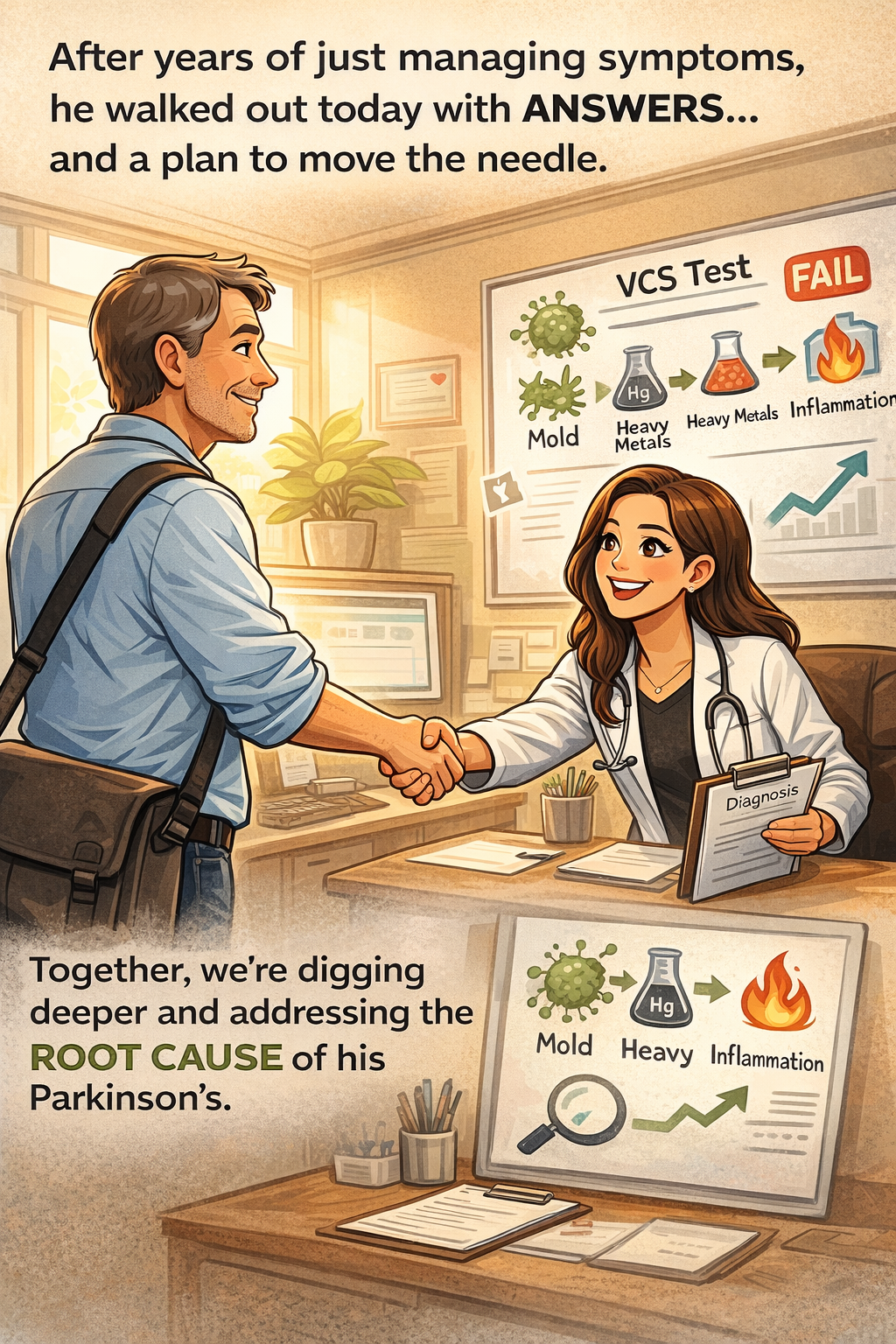
A New Warrior, and a Shift from Defeat to Hope
Yesterday, I welcomed a new warrior into The Lyday Center.
He walked in carrying something I see far too often in patients with complex neurological disease: defeat. Not because he hadn’t tried. Not because he hadn’t done the work. But because after years of searching—even working with functional medicine—no one had ever clearly told him why his Parkinson’s developed or what might actually be driving it.
By the time he left, something had changed.
For the first time in years, he left a doctor’s appointment with hope.
“I’ve Been Asking for Root Cause Healing”
Michael (name changed for privacy) is in his late 50s and was diagnosed with Parkinson’s in March of 2025. Like many people with this diagnosis, his care to date has focused almost entirely on symptom management.
Medication.
More medication.
Adjustments that didn’t seem to change how he felt day to day.
He told me plainly:
“My neurologist focuses on symptoms, not root cause. I feel like I have no real information about what’s happening in my body.”
Despite doing everything right—eating well, exercising daily, limiting sugar and alcohol, staying active, taking supplements, and even working with a functionally trained provider—he had never been given a unifying explanation.
He came in tired.
He came in anxious.
He came in sleeping about four hours a night, waking consistently between 1–2 a.m. for the past five years.
He came in with fatigue, brain fog, and subtle but persistent left-sided tremor—just enough to remind him that something wasn’t right.
And he came in nervous. Not just about Parkinson’s—but about being at another doctor’s office where nothing might change.
When the Timeline Starts to Make Sense
As we talked, a clearer picture emerged.
Years before diagnosis, Michael went through a period of intense, prolonged stress—leaving a family business, months of sleepless nights, anxiety that wouldn’t shut off, a nervous system stuck in overdrive.
Around that same time, he noticed subtle changes in his gait on the left side. Nothing dramatic. Easy to ignore.
But the body keeps score.
Add to that:
A lifetime of high cognitive stress in a demanding career
Exposure to industrial solvents and degreasers earlier in life
Years of high-impact recreational activities
Multiple tick exposures with no formal Lyme treatment
A close family member with Lyme disease
Chronic insomnia preceding neurological symptoms by years
This is not a story of “bad luck.”
It is a story of load.
Parkinson’s Is Not the Beginning — It’s the Result
This is one of the most important truths I shared with Michael:
Parkinson’s is not the beginning of the story.
It is the result of years of accumulated stressors overwhelming the nervous system.
Neurodegeneration does not appear overnight. It develops when inflammation, toxins, infections, and nervous system dysregulation quietly smolder for years—until the brain can no longer compensate.
And for the first time, Michael was told plainly:
There are identifiable drivers we can investigate and address.
Why This Case Struck Me So Deeply
What struck me most about Michael’s case wasn’t just his diagnosis—it was how much he had already done right. He ate well. He exercised consistently. He limited sugar and alcohol. He took care of his body and sought help early, even pursuing functional medicine when conventional answers fell short. And yet, he still developed Parkinson’s.
But what impacted me most was that despite asking the right questions, he couldn’t find clear answers for years.
With degenerative nervous system conditions like Parkinson’s, time matters. The earlier we identify and address the drivers—whether inflammatory, toxic, infectious, or metabolic—the more leverage we have to protect neurons, calm neuroinflammation, and change the trajectory of disease. The sooner we see patients like Michael, the less backtracking, fewer hoops, and gentler the healing journey can be.
This case was a powerful reminder of why access to true root-cause medicine matters—and why hope should begin at the start of diagnosis, not years into it.
What We Found — and Why It Matters
On his initial visit, testing immediately pointed us in a clear direction:
Failed VCS testing, consistent with neuroinflammation
Evidence of mold intoxication
Elevated barium, a known neurotoxic metal
Suddenly, the pieces aligned.
Mold toxins.
Heavy metals.
Chronic stress.
Possible untreated tick-borne illness.
Years of sleep disruption.
This is not about blaming the past—it’s about finally naming the problem.
A Different Kind of Parkinson’s Conversation
For years, Michael had been offered one path: medication that didn’t meaningfully change his quality of life.
Yesterday, we talked about something very different:
Reducing inflammatory and toxic burden
Supporting detox pathways safely
Addressing mold exposure at the root
Protecting and supporting neurons
Exploring advanced therapies when appropriate, including apheresis and regenerative options
Most importantly, we talked about moving the needle—not curing Parkinson’s overnight, but changing the trajectory of the disease.
That conversation alone shifted something profound.
Leaving With Hope
Michael walked in feeling worn down and uncertain.
He left knowing:
There is a why
There is a plan
And there is a path forward
He left knowing he is not broken.
He left knowing this isn’t “just how it is.”
He left knowing someone is finally looking at the whole picture.
And that matters more than any single supplement or medication.
To Those Living With Parkinson’s (or Loving Someone Who Is)
If you or someone you love has Parkinson’s and you’ve been told there’s nothing to do beyond managing symptoms—please hear this:
There is always more to understand.
There is always a deeper story.
And there is always room for hope when we ask better questions.
Welcoming this new warrior was a reminder of why I do this work.
Not to promise miracles—but to offer clarity, partnership, and possibility where there was once only resignation.
And sometimes, that’s the most powerful medicine of all.