
Healing Requires Safety: Why Your Support Network Matters More Than You Think
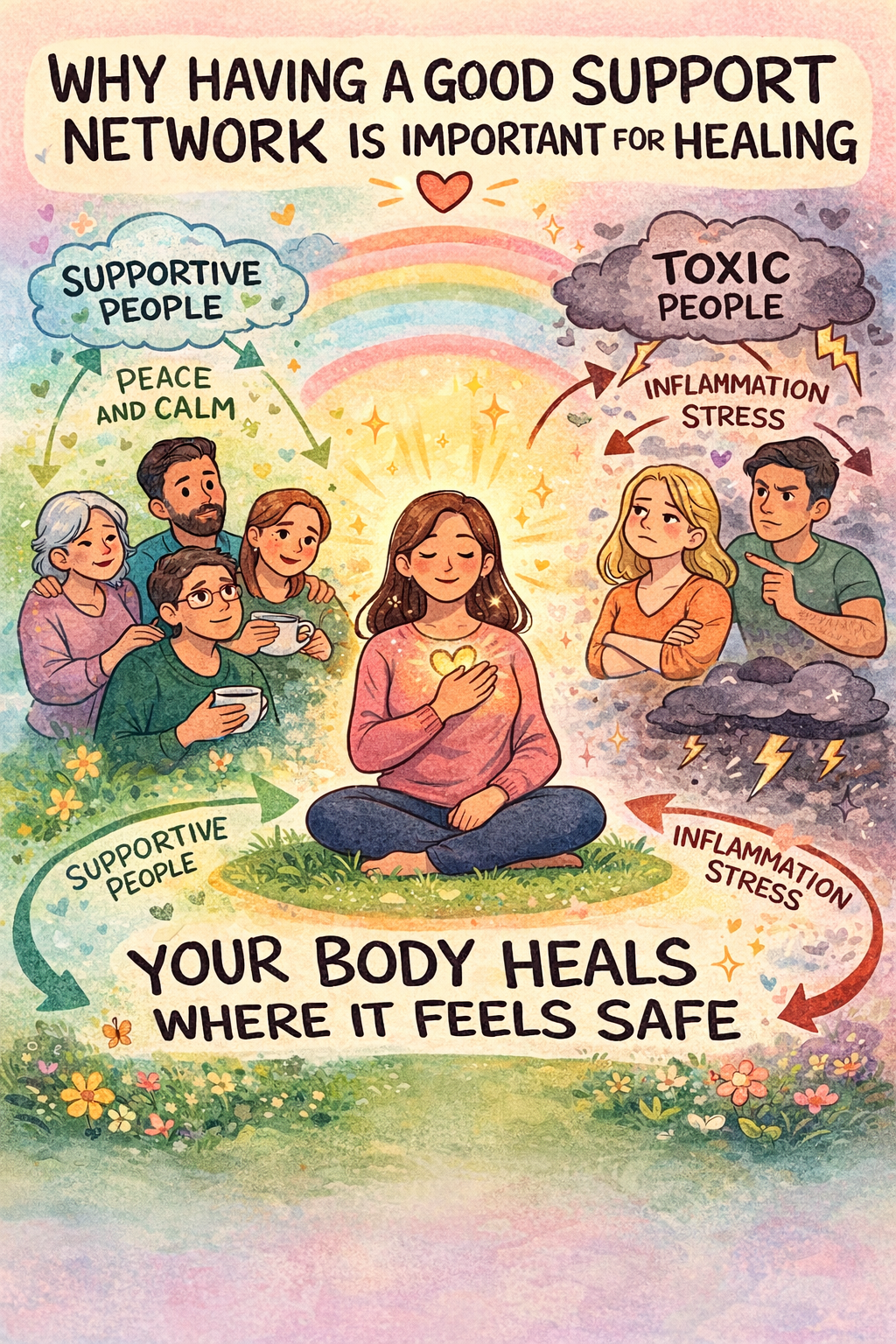
One of the hardest truths I see in this work is this:
Some of the kindest, most empathetic, most selfless people are surrounded by relationships that are quietly keeping them sick.
My patients — my cupcakes, my warriors — are often the ones who will do anything for anyone. They are thoughtful. Loyal. Deeply compassionate. They overfunction, overgive, over-accommodate, and override their own needs for years. They become the strong one, the helper, the peacekeeper, the one who keeps everything moving.
Until one day, the body says no more.
When the wheels come off the bus and the body can no longer run on adrenaline, cortisol, people-pleasing, and survival mode, the truth begins to surface. And sometimes that truth is not just about mold, Lyme, Bartonella, mitochondria, or trauma. Sometimes the truth is that the nervous system has never felt safe enough to heal.
Your body cannot heal where it does not feel safe
This is one of the most important lessons I have learned in caring for people with chronic illness:
You cannot fully heal in an environment of chronic emotional threat.
You may be taking the right binders. You may be cleaning up mold. You may be addressing co-infections. You may be doing all the supplements, all the detox, all the therapies. But if your body is still bracing every day for criticism, volatility, gaslighting, control, or emotional instability, your healing will always hit a ceiling.
The body is wise. It knows when it is not safe.
And when someone is living with a narcissistic, emotionally abusive, or highly dysregulated partner or family system, their nervous system often stays locked in fight, flight, freeze, or fawn. That means inflammation stays high. Hormones stay off. Sleep suffers. Digestion suffers. The immune system never gets to put its weapon down long enough to repair.
For many of my patients, the missing piece is not more effort.
It is safety.
The people who need the most care often attract those who cannot give it
This pattern is so common it breaks my heart.
The most loving people often attract relationships where they are valued for what they provide, not for who they are. They attract people who are happy to receive endless empathy, endless flexibility, endless support — until the moment that person becomes sick and actually needs something back.
That is when the mask often falls.
That is when some patients realize the person closest to them cannot tolerate their vulnerability. Cannot hold space for their healing. Cannot respond with softness, accountability, or support. Instead, the illness gets blamed. The patient gets pathologized. Their reality gets minimized. Their boundaries become a threat.
And that realization can be devastating.
Because when you are already exhausted, inflamed, overwhelmed, and scared, the thought of losing your relationship may feel more terrifying than staying in one that is harming you.
But that fear is not the truth.
Being alone is not more dangerous than being chronically unsafe
I know leaving a toxic relationship can feel impossible. It can feel like stepping into the unknown with no guarantee of being held. It can feel like choosing grief, chaos, paperwork, parenting stress, financial stress, and uncertainty — all while trying to heal.
But what I have seen again and again is this:
The body often begins to change the moment a person stops betraying themselves.
Not because life suddenly becomes easy. It usually does not.
But because the nervous system finally starts receiving a new message:
I am no longer trapped.
I am no longer pretending.
I am no longer forcing myself to survive what is hurting me.
I am allowed to tell the truth.
I am allowed to choose me.
And that shift matters more than most people realize.
One of my warriors reminded me of this recently
I saw a patient back recently who had been very sick for a long time. Years of mold exposure. A history that kept pointing to one missing puzzle piece after another. Chronic inflammation. Exhaustion. Brain fog. Sinus issues. GI symptoms. A body that had been running on fumes for far too long.
Like many people with chronic illness, he had spent years trying to push through. He had built a life around overriding his body. He was functional, driven, responsible, and deeply committed to everyone around him. But his system was depleted, and it had been for a long time.
In the short time between visits, he took space. He got away. He received treatment. He spent time alone. He had room to think, breathe, feel, and listen to himself without the constant noise of overfunctioning and relational stress.
And what became clear for him was not just the biology.
It was the truth of his life.
He could finally see that one of the biggest barriers to his healing was not only the mold, the infections, or the inflammation. It was the chronic unsafety of a relationship that required him to abandon himself in order to keep it going.
He made hard changes.
Scary changes.
The kind of changes most people avoid until life forces their hand.
And the result? In a matter of weeks to months, he was feeling better than he had in years. More energy. More clarity. Better sleep. Better focus. Better emotional regulation. More access to himself. More hope. More life.
Did everything magically disappear? No.
But once his body began to feel safer, it could finally respond to treatment in a different way.
That is not a coincidence.
Healing is biological, but it is also relational
We cannot separate the nervous system from the healing process.
If your body is constantly scanning for danger in your own home, your own marriage, your own family, your own friendships, that matters. If you are always the one carrying everyone else, that matters. If you are living in an environment where your pain is dismissed, your reality is questioned, or your boundaries are punished, that matters.
Your support network is not a luxury.
It is treatment.
Supportive people help regulate your nervous system. They help your body drop out of survival mode. They remind you that you are not crazy, not lazy, not broken, and not alone. They help you conserve energy for healing instead of using it all for self-protection.
And sometimes the support network you need is not the one you started with.
Sometimes healing requires building a new one.
What real support looks like
A good support network does not have to be huge. It just has to be real.
It might look like:
A therapist who helps you unwind old trauma patterns.
A practitioner who believes you.
A friend who checks in without draining you.
A sibling who tells the truth.
A parent who finally respects your boundaries.
A support group that helps you feel seen.
A bodyworker who helps your system exhale.
A spiritual practice that reminds you that your life still belongs to you.
Time alone that lets you hear your own voice again.
Real support is not people who tell you to push through.
Real support is people who make healing feel safer.
If this is your story, please hear me
If your illness has revealed painful truths about your relationships, you are not failing.
You are waking up.
If your body seems to improve when you are away from certain people, pay attention.
If you feel calmer, clearer, less inflamed, more rested, or more like yourself when you are alone, in nature, with safe people, or outside the usual environment, pay attention.
Your body is telling you something.
And if you know deep down that a relationship is keeping you sick, it may be time to stop asking whether you can endure it and start asking whether you are allowed to heal.
You are.
Trust what opens when you choose yourself
One of the most beautiful things I have seen is what happens when patients finally set a real intention for healing.
When they say:
I want truth.
I want peace.
I want safety.
I want my life back.
I am done abandoning myself.
Something begins to move.
Call it God. Call it grace. Call it the universe. Call it alignment.
But when you stop forcing yourself to stay where you are not safe, life has a way of meeting you. The right people appear. The right doors open. The right support arrives. Not always instantly, and not always in the form you expected — but it comes.
You do not need to know every step before you begin.
You just need enough courage to stop choosing what is hurting you.
Because healing does not only happen through supplements, detox, and protocols.
Healing happens when the body finally believes:
I am safe now.
I can rest now.
I can tell the truth now.
I can heal now.
And sometimes, that is where the real recovery begins.