Night Owl Stories…
What I do to get a good night’s sleep - Zenbiome, LDN, PS, SPM Active
I Stayed Up Until Midnight...
...on purpose.
And I didn't panic.
If you've never struggled with chronic illness, that sentence probably sounds ridiculous.
But if you've lived with mold illness, Lyme disease, long COVID, neuroinflammation, MCAS, chronic fatigue, or just the mysterious feeling that your body is no longer your own...
You know exactly why that's a big deal.
Sleep Was Never My Problem
I'll be honest.
Before I moved into the toxic apartment...
Before the toxic relationship...
Before the water-damaged building...
Before three mandatory COVID vaccinations for work...
I never thought about sleep.
It simply happened.
I know the stories of my mom vacuuming while I was a baby because I would sleep through anything.
As a teenager?
I could sleep until noon on the weekends without batting an eye.
Dragging myself out of bed for school was a far bigger problem than getting to sleep.
Then came medical school.
Residency.
ICU call.
Delivering babies in the middle of the night.
Being awakened by pagers every few hours.
I actually became so conditioned to hospital life that I changed my pager to vibrate.
Everyone else's pager would send the whole call room into chaos.
Mine would simply buzz.
Somehow, that gentle vibration trained my brain to go from deep sleep to "someone's dying" in a fraction of a second.
Looking back...
That probably wasn't great for my nervous system.
But here's the interesting part.
Even after brutal nights on call...
I could still sleep.
If I had a chance to nap during the day, I slept.
When residency was over, I recovered.
Sleep still worked.
Then Everything Changed
Looking back, I honestly can't tell you which straw finally broke the camel's back.
Was it selling the home I absolutely loved because I had decided to chase my dream of functional medicine?
Was it moving in with someone whose emotional world kept my nervous system on high alert?
Was it the water damage and mold exposure?
Was it the mandatory COVID vaccinations?
Was it all of the above?
Probably.
What I do know is this...
For the first time in my life...
I stopped waking up feeling rested.
That simple feeling most people take for granted...
Gone.
There was no stretch.
No "Wow, I slept well."
No feeling that my body had actually recovered overnight.
Instead...
Every morning felt like I had never really gone to sleep at all.
Now, looking back with everything I know today...
I know exactly what it was.
Neuroinflammation.
At the time?
I had no idea.
I Became That Person
I laugh about it now.
But during those years I became obsessed with optimizing sleep.
Blue light.
EMFs.
Water filters.
Mattresses.
Air quality.
Noise.
Blackout curtains.
Supplements.
Devices.
Temperature.
Every sleep hack known to mankind.
If there was one more thing I could buy, test, optimize, or change...
I did it.
Because I thought one of those things would finally make me wake up feeling rested again.
But nothing moved the needle.
Not because those things don't matter.
Many of them absolutely do.
But because my brain was inflamed.
I wasn't simply sleeping poorly.
My body had lost its ability to create restorative sleep.
There's a huge difference.
The Garbage Can Theory
One of the analogies I use with patients is this:
Imagine your body is a garbage can.
Every infection.
Every toxin.
Every stressor.
Every mold exposure.
Every sleepless night.
Every emotional trauma.
Every inflammatory event.
Throws another bag into that garbage can.
For years...
The garbage can keeps holding more.
Until one day...
It doesn't.
And suddenly people say things like:
"I guess I'm just getting older."
"It must be menopause."
"It must be perimenopause."
"It must be stress."
"It must be insomnia."
Sometimes those things absolutely contribute.
But many times...
The garbage can is simply overflowing.
And until we start taking bags out...
Nothing changes.
You can add hormones.
Sleeping pills.
Supplements.
Meditation.
The fanciest mattress money can buy.
But if the inflammation remains...
You'll still wake up exhausted.
Last Night
Last night I did something completely irresponsible.
Or at least...
The old version of me would have thought so.
At 9:45 PM...
I started a movie.
A full-length movie.
No calculations.
No anxiety.
No worrying about how awful tomorrow would be.
Just...
"I really want to watch this."
(For the record...
Voicemails for Isabella on Netflix.
Highly recommend.)
A year ago?
Absolutely not.
Five years ago?
Not a chance.
Back then, sleep had become sacred.
Not because it was working.
Because I was desperately chasing the feeling of being rested.
Every minute mattered.
Every hour mattered.
Every bedtime routine mattered.
And none of it was enough.
This Morning
The alarm went off at 5 AM.
Do you know what happened?
Nothing.
I got up.
Started my day.
No brain fog.
No regret.
No feeling like I'd been hit by a truck.
Just...
Life.
It hit me this morning that this is one of the biggest signs that I'm healing.
Not that I stayed up late.
That I didn't fear staying up late.
My nervous system is no longer living in survival mode.
My brain isn't constantly calculating the consequences of every decision.
I'm starting to trust my body again.
And that...
May be one of the greatest gifts healing has given me.
To Anyone Chasing Sleep...
If you're reading this while trying another supplement...
Another sleep medication...
Another pillow...
Another gadget...
Please hear me.
Sleep is incredibly important.
But sometimes poor sleep isn't the problem.
It's the symptom.
If your brain is inflamed...
If your nervous system is stuck in survival mode...
If your body's inflammatory bucket is overflowing...
You may never wake up refreshed until you address the reason your body can't restore itself.
There is hope.
I know because I've lived both sides.
And today...
I stayed up late watching a movie.
Not because I forgot how important sleep is.
Because for the first time in years...
I trusted my body enough to simply enjoy the moment.
Sometimes healing isn't measured by the hours you sleep.
Sometimes it's measured by the fear you've finally left behind.
And let me tell you...
The movie was worth it.
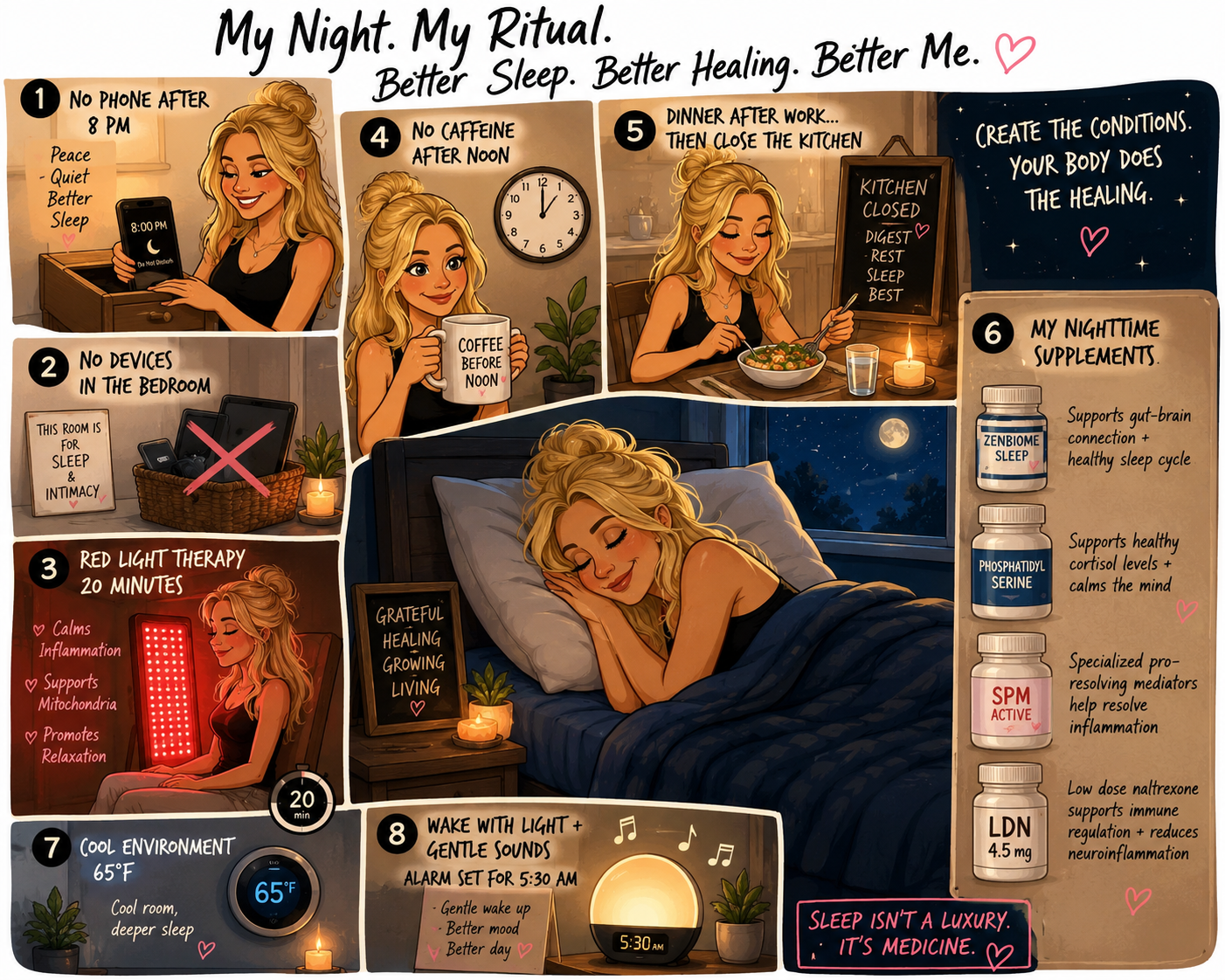
Dr. Lyday's Nighttime Routine
The Sleep Optimization Checklist I Personally Follow
One of the most common questions I get is:
"What do YOU do to sleep?"
The answer may surprise you.
It's not one magic supplement.
It's creating an environment where your brain and nervous system know it's safe to rest.
Here is the nightly routine that has helped me go from chasing sleep to finally waking up feeling refreshed again.
1. Put the Phone Away by 8:00 PM
This has been one of the biggest game changers.
Phones stimulate the brain in more ways than we realize:
Blue light suppresses melatonin.
Notifications keep the nervous system on alert.
Emails, social media, and news activate stress pathways when your brain should be winding down.
I try to put my phone away by 8:00 PM and leave it there until morning.
2. No Devices in the Bedroom
Your bedroom should become associated with two things:
Sleep
Intimacy
Not work.
Not scrolling.
Not answering emails.
Creating this separation teaches your brain that when you walk into the bedroom, it's time to relax.
3. Red Light Therapy for 20 Minutes
One of my favorite additions.
I spend about 20 minutes under my PlatinumLED red light before bed.
Why?
Red and near-infrared light may:
Support mitochondrial function
Promote cellular repair
Help calm inflammation
Encourage relaxation without suppressing natural melatonin production
It's become one of my favorite ways to transition from "doctor mode" to "sleep mode."
4. No Caffeine After Noon
Even if you can fall asleep after an afternoon coffee...
Caffeine may still reduce deep sleep and REM sleep.
Its effects can last much longer than people realize.
For me:
No caffeine after 12:00 PM.
5. Eat Dinner After Work... Then Close the Kitchen
I try to eat dinner after work and avoid unnecessary snacking later in the evening.
Going to bed while constantly digesting food may interfere with restorative sleep for some people.
Giving your digestive system a chance to wind down is just as important as letting your brain wind down.
6. My Evening Supplements
Everyone's needs are different, but these are part of my current routine:
Zenbiome Sleep
Supports the gut-brain connection.
Helps promote a healthy sleep cycle and a calmer nervous system.
Phosphatidylserine
Helps support healthy cortisol regulation.
Particularly helpful for people whose brains feel "wired but tired."
SPM Active
Specialized pro-resolving mediators help the body naturally resolve inflammation rather than simply suppress it.
Less inflammation often translates into better recovery overnight.
Low-Dose Naltrexone (LDN) 4.5 mg
Part of my neuroinflammation protocol.
Helps regulate immune function and reduce neuroinflammation.
For me, it's been an important piece of supporting restorative sleep while addressing root causes.
7. Keep the Bedroom Cool
Temperature matters.
I keep our bedroom around 65°F (18°C).
A cooler environment helps support the body's natural nighttime drop in core temperature, which promotes deeper sleep.
8. Wake Up Naturally with Light
How you wake up is just as important as how you fall asleep.
Instead of an alarm that jolts me awake, I use an alarm that gradually increases light and gentle sounds before my scheduled wake time.
Mine is set for 5:30 AM.
It's a much calmer way to begin the day and supports a more natural transition into wakefulness.
The Most Important Thing
Remember...
Sleep isn't something you force.
It's something your body allows when it feels safe.
If you're lying in bed exhausted but never waking up refreshed...
It may not be because you need another sleep supplement.
It may be because your body is still carrying too much inflammation, too much stress, or too much physiologic burden.
For years, I chased sleep.
Now I focus on creating the conditions that allow sleep to happen naturally.
Your nighttime routine doesn't have to be perfect.
Just be consistent.
Small changes, repeated every night, can lead to remarkable improvements over time.
Sleep isn't a luxury.
It's one of the most powerful forms of medicine your body has.