
Why Can’t I Lose Weight?
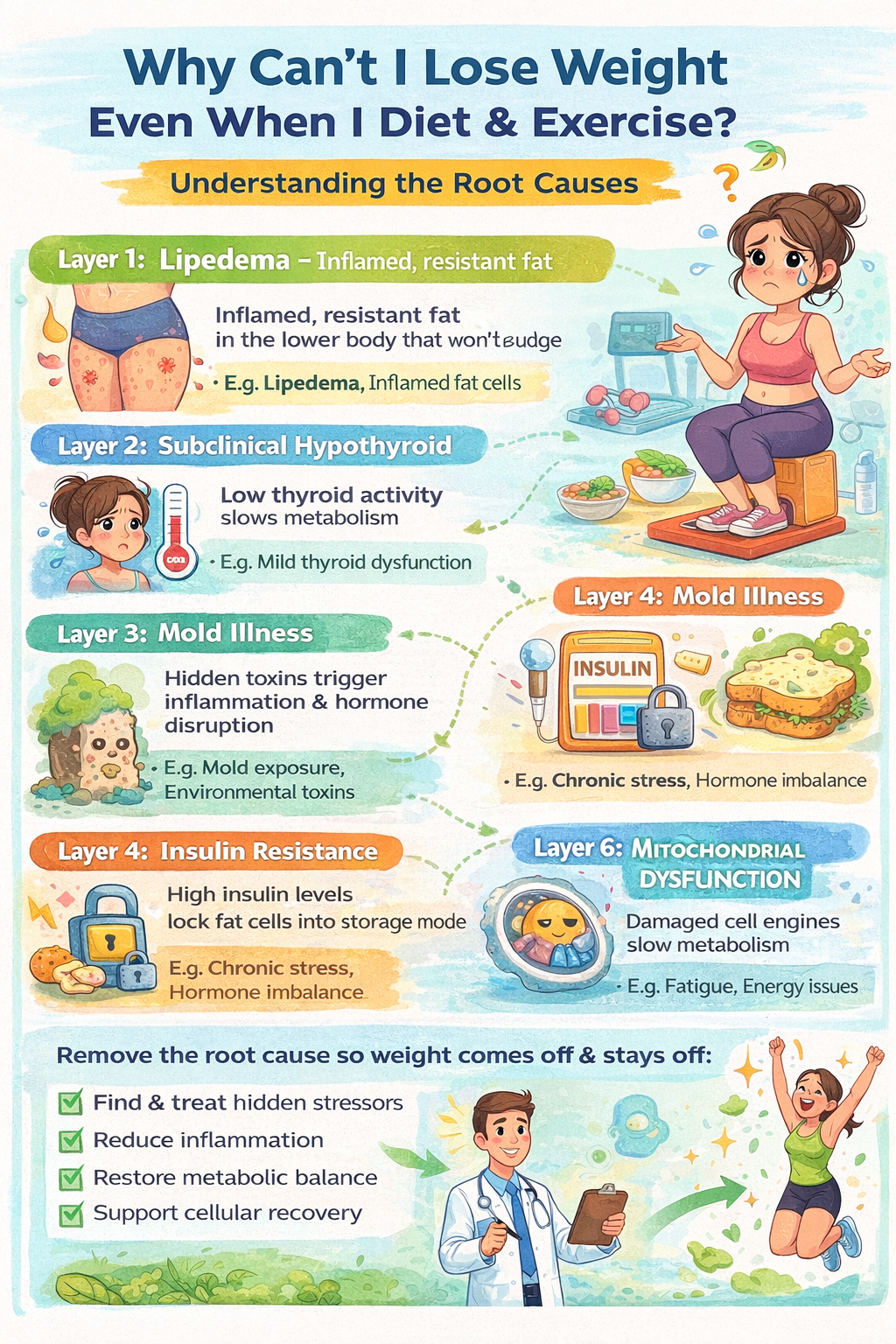
Why Can’t I Lose Weight Even When I Diet and Exercise?
This is one of the most heartbreaking conversations I have with patients.
They sit across from me and say something like:
“I don’t understand what I’m doing wrong.”
They’re exercising.
They’re cooking healthy meals.
They’re skipping dessert.
They’re trying.
And yet the scale doesn’t move.
Or worse… it moves in the wrong direction.
For many people, the problem isn’t discipline.
The problem is biology.
The human body is incredibly intelligent. When it senses danger or stress, it shifts into survival mode. In survival mode, the body holds onto energy stores — which means holding onto fat.
So if your body believes it is under threat, it will resist weight loss no matter how perfectly you diet or exercise.
Over the years, I have seen several common root causes that keep the body trapped in this metabolic “lockdown.”
Let’s walk through them layer by layer.
Layer One: Lipedema — The Fat Disorder Most Doctors Miss
One of the most misunderstood causes of weight resistance is lipedema.
Lipedema is a chronic inflammatory fat disorder that affects millions of women worldwide, yet most physicians are never trained to recognize it.
In lipedema:
Fat cells become inflamed and dysfunctional
Fat accumulates primarily in arms and legs
The tissue becomes painful and prone to bruising
The fat becomes resistant to diet and exercise
Many women with lipedema are extremely disciplined about their health.
They run.
They lift weights.
They eat clean.
And still the fat does not move.
This is because lipedema fat behaves differently from normal fat. Once inflamed, these cells create an environment where the body continues to store energy instead of releasing it.
For these women, the issue was never willpower.
It was an undiagnosed medical condition.
Layer Two: Subclinical Hypothyroidism
The thyroid gland acts as the body’s metabolic thermostat.
It regulates:
metabolism
energy production
temperature
fat burning
hormonal balance
When thyroid function is low, metabolism slows down.
In classic hypothyroidism this is easy to diagnose.
But many people suffer from subclinical hypothyroidism, where lab numbers may appear “normal” while the body is still functioning at a metabolic disadvantage.
Common symptoms include:
weight gain
fatigue
brain fog
dry skin
cold intolerance
hair thinning
When thyroid hormone signaling is sluggish, the body simply cannot burn energy efficiently.
You could eat perfectly and still struggle to lose weight.
Layer Three: Mold Illness and Environmental Toxins
Another hidden cause of weight resistance is toxin exposure, especially mold.
Certain molds produce chemicals called mycotoxins that can disrupt nearly every system in the body.
These toxins can trigger:
chronic inflammation
immune system activation
hormone disruption
mitochondrial dysfunction
insulin resistance
The body interprets this as danger.
When the body senses danger, it protects itself by holding onto energy reserves, which means fat storage.
Many patients with mold illness describe gaining weight despite eating less than they used to.
Their bodies are not failing them.
Their bodies are trying to protect them.
Layer Four: Insulin Resistance
Insulin is one of the most powerful hormones controlling fat storage.
When insulin levels remain elevated, the body stays in fat storage mode.
Common drivers of insulin resistance include:
chronic stress
poor sleep
inflammation
environmental toxins
genetic predisposition
hormonal imbalances
Even when someone reduces calories, insulin resistance can make it extremely difficult for the body to access stored fat.
The body essentially becomes metabolically locked.
Layer Five: Chronic Inflammation
Inflammation is the common thread connecting nearly every metabolic condition.
Chronic inflammation tells the body:
“Something is wrong.”
When that signal is constant, the body shifts into protective mode.
This can lead to:
slowed metabolism
increased fat storage
fatigue
hormone disruption
Sources of chronic inflammation can include:
infections
autoimmune disease
toxins
food sensitivities
stress
Until the inflammation is addressed, the body often refuses to let go of weight.
Layer Six: Mitochondrial Dysfunction
Inside every cell in your body are tiny structures called mitochondria.
These are the energy factories of the body.
When mitochondria are functioning well, they efficiently convert food into usable energy.
But when they are damaged by inflammation, toxins, infections, or stress, energy production drops.
Symptoms of mitochondrial dysfunction can include:
fatigue
exercise intolerance
brain fog
metabolic slowdowns
Without healthy mitochondria, the body simply cannot burn fuel effectively.
When All These Layers Stack Together
For many people struggling with weight, it isn’t just one factor.
It is several layers stacking together.
For example:
A patient may have:
mild thyroid dysfunction
mold exposure
inflammation
insulin resistance
All at the same time.
From the outside it may look like a simple weight problem.
But inside the body, it is a complex metabolic storm.
The Good News: The Body Wants to Heal
Here is the part that gives me hope every single day.
The body is designed to heal.
When we remove the obstacles blocking normal metabolism, the system often recalibrates naturally.
This means addressing root causes such as:
toxin burden
infections
inflammation
hormonal imbalance
mitochondrial health
Instead of forcing weight loss through restriction, we help the body restore balance.
And when the body feels safe again, it often begins to release weight on its own.
A Root Cause Approach to Healing
At The Lyday Center, we approach weight resistance as a signal from the body, not a failure of discipline.
Our goal is to identify the biological drivers that may be interfering with normal metabolism.
This may include evaluating:
inflammatory markers
thyroid function
toxin exposure
mitochondrial health
metabolic signaling
For some patients, advanced therapies that reduce inflammatory burden and support cellular recovery can also play a role in restoring metabolic flexibility.
When the body is no longer stuck in survival mode, something remarkable often happens:
Energy returns.
Inflammation decreases.
And the weight that once felt impossible to lose begins to move.
Your Body Is Not Broken
If you have been dieting, exercising, and doing everything you were told to do but the weight will not move, please hear this:
Your body is not broken.
It may simply be carrying layers of stress that have never been addressed.
And when those layers are uncovered and treated, healing can begin.
Sometimes the journey to weight loss is not about trying harder.
It is about finally understanding why the body has been holding on in the first place.