
Why I Became A Medical Detective…
Environmental medicine, Mold, Lyme, Babesia, Bartonella, Lipidema
Why I Became a Medical Detective: I’m Not Standing on the Shore. I’m in the Water With You.
There are doctors who study chronic illness.
There are doctors who treat chronic illness.
And then there are those of us who have lived it.
I wish I could tell you that everything I know about chronic illness came from medical school, conferences, textbooks, certifications and thousands of patient visits.
It didn't.
Some of the most important lessons I've learned came from lying awake at night wondering:
Am I ever going to feel like myself again?
They came from looking at a body that no longer felt like mine.
From feeling betrayed by it.
From being the doctor who was supposed to have answers—and realizing I didn't have answers for myself.
I Know What It Feels Like to Reach the End of the Road
I've spent hundreds of thousands of dollars trying to get well.
Supplements.
Testing.
Treatments.
Protocols.
I've thrown away belongings after leaving a moldy environment because I was determined to start over safely...
Only to move somewhere else and discover mold again.
Three times.
I've watched plans change.
I've watched dreams disappear.
I've swallowed handfuls of supplements and wondered whether any of them were doing a damn thing.
I've had moments when I genuinely wondered whether my body was ever going to cooperate with me again.
And that's why when one of my patients—one of my warriors—sits across from me and says:
“Doc, I have tried EVERYTHING.”
I believe them.
Because I've said those exact words.
So This Week, I Turned the Microscope Back on Myself
After Gio and I returned from Minneapolis, I decided it was time.
Test it all.
Not because every specialty test automatically provides an answer.
But because I wanted another comprehensive look at my physiology and to determine which findings might actually be clinically meaningful.
I ordered a broad panel of testing that included environmental/toxin assessment, micronutrients and inflammatory and autoimmune markers.
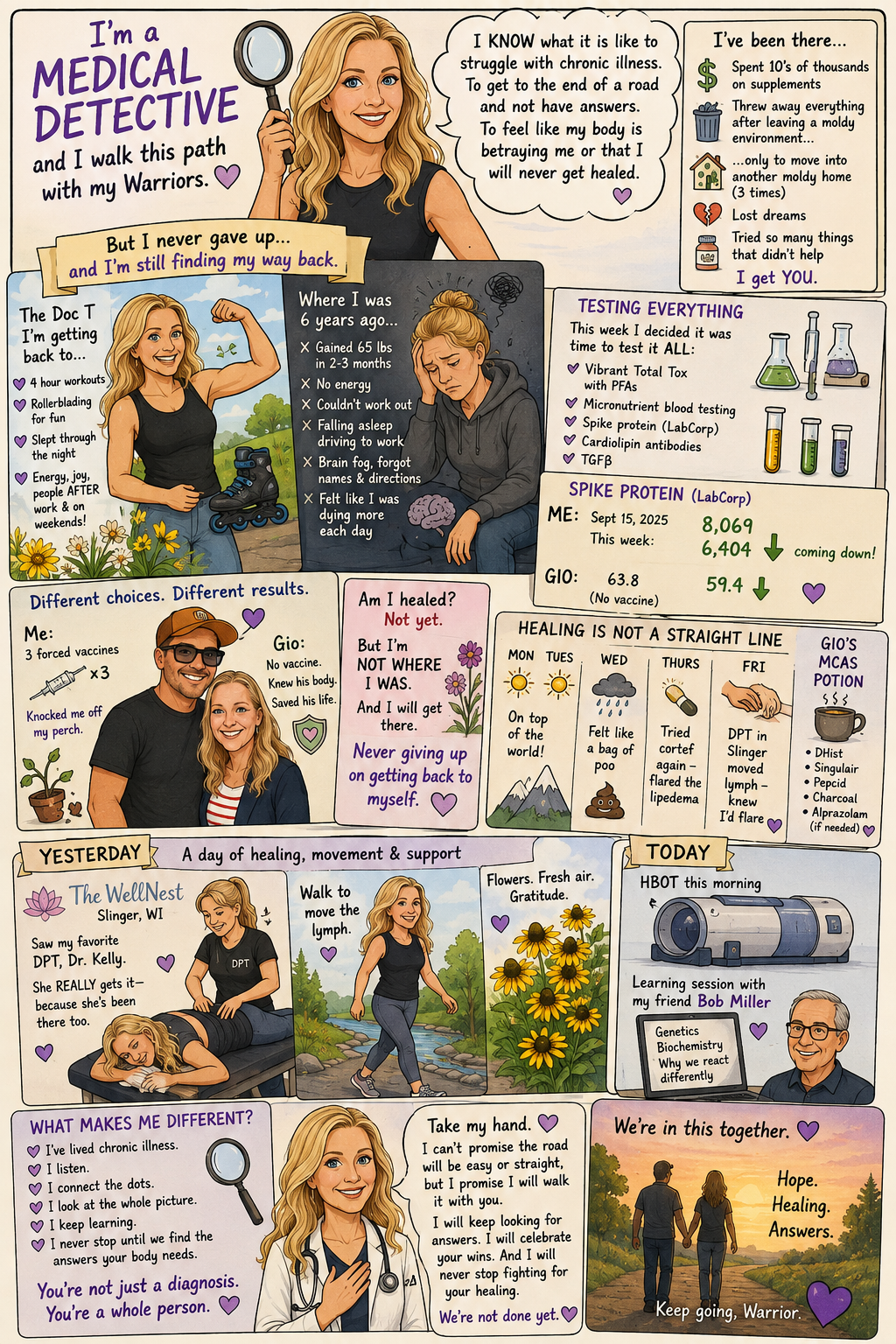
I also repeated my SARS-CoV-2 anti-spike antibody level.
And that result stopped me in my tracks.
In September 2025, my result was:
8,069
This week:
6,404.
Down substantially.
Is 6,404 a validated measure of how much spike protein is physically sitting inside my tissues?
No.
It isn't.
This assay measures my body's antibody response to the SARS-CoV-2 spike protein, which can reflect previous vaccination and/or infection. Medicine does not currently have a validated cutoff telling me that 6,404 is “toxic,” nor can I claim that lowering this number proves that a treatment is removing spike protein from my body.
But it is one more longitudinal data point in my story.
And alongside that number is something even more important:
I am getting better.
Because There Was a Time When I Barely Recognized Myself
My health changed dramatically during the COVID era.
For me, the most dramatic shift occurred temporally after receiving the COVID vaccinations required while I was still working in hospital-based medicine.
I gained an enormous amount of weight over a remarkably short period.
My energy disappeared.
Exercise—the thing that had always made me feel alive—became nearly impossible.
There were days when staying awake driving to work was a struggle.
My brain stopped behaving like my brain.
I forgot things that had just happened.
I would drive somewhere I had driven routinely for years and suddenly lose my bearings.
I forgot the name of a nurse I worked with.
I would make it through the workday and have absolutely nothing left.
No energy.
No reserve.
No umph.
And perhaps the hardest part?
I lost some of my joy.
The old Doc T could work all day and still want to see people afterward.
She could do a four-hour workout and decide later:
“You know what sounds fun? Rollerblading.”
Just for shits and giggles.
She slept.
She woke up rested.
She loved being around people.
And suddenly I couldn't find her.
But Here Is the Part I Want Every Chronically Ill Person to Hear
She isn't gone.
I am finding her again.
Piece.
By.
Piece.
Am I at the finish line?
Hell no.
But am I where I was several years ago?
Not even close.
My cognition is dramatically better than it was.
My stamina is improving.
I can tolerate more.
I can work.
I can learn.
I can travel.
I can investigate.
I can have days where I think:
There you are, Doc T. I knew you were still in there.
And then I have Wednesday.
Wednesday this week?
I felt like a bag of poo.
Welcome to chronic illness.
Healing Is Not a Straight Line
Monday and Tuesday?
On top of the world.
Wednesday?
Nope.
Thursday?
I experimented again with something my body had previously struggled with and didn't like the response.
Friday?
I drove to Slinger to see my favorite DPT.
Why?
Because she is one of the few people who can look at me during a flare and truly understand what I'm describing.
Because she has lived it too.
Sound familiar?
I knew that moving a lot of lymph and doing bodywork might mean I wouldn't feel fabulous afterward.
And Gio?
Gio knows the drill.
He knows when I'm having a rough day.
He knows where everything is.
He knows when I need to stop pushing.
He knows that sometimes the smartest thing we can do is reassess instead of assuming every flare means “detox” or that feeling worse automatically means a treatment is working.
Because chronic illness teaches you humility.
The body always gets a vote.
And Today? I Keep Going.
This morning I'm spending my first few hours in HBOT.
Then I'm jumping into another learning session with my friend Bob Miller because I want to understand more about genetics, biochemistry and why two people exposed to seemingly similar things can have completely different outcomes.
That fascinates me.
Why does one person walk into a water-damaged building and feel fine while another becomes profoundly ill?
Why does one person recover beautifully after an infection while another develops persistent fatigue, brain fog, dysautonomia and post-exertional crashes?
Why does one patient tolerate a protocol beautifully while another reacts to practically everything?
Why did Gio and I experience the COVID era so differently?
Those are the questions that keep me learning.
This Is What Makes Me a Medical Detective
I don't believe that every symptom is mold.
I don't believe every symptom is Lyme.
I don't believe every symptom after COVID is caused by spike protein.
And I don't believe one laboratory value can explain an entire human being.
I believe in patterns.
I believe in timelines.
I believe in listening when someone says:
“Something happened, and I have never been the same.”
I believe in looking at what happened before the crash.
What changed?
What exposures occurred?
What infections?
What medications?
What injuries?
What hormonal changes?
What happened to sleep?
What happened to the nervous system?
What happened to nutrition?
What happened to movement?
What diagnoses have already been established—and which possibilities haven't been adequately investigated?
Then we start putting the pieces together.
That is medical detective work.
And Here Is the Biggest Difference
When you sit across from me exhausted, frustrated, scared and carrying a three-inch binder of medical records...
I get you.
When you tell me you've spent a fortune trying to get better...
I get you.
When you tell me you've thrown away your belongings because of mold...
I REALLY get you.
When you tell me everyone says your labs look fine but you know damn well you aren't fine...
I understand why you're frustrated.
When you tell me you had three great days and then suddenly crashed again...
I know how defeating that feels.
When you say:
“I'm scared this is just who I am now.”
I know that fear too.
Not because I read about it.
Because I've lived versions of it.
I Am Walking This Path With My Warriors
I will never promise someone that I can cure every chronic illness.
Medicine doesn't give any of us that power.
But I can promise something else.
I will remain curious.
I will keep learning.
I will keep asking why.
I will celebrate your wins.
I will take your setbacks seriously.
I will change course when something isn't working rather than forcing your body through a protocol simply because that's what the protocol says.
And I will never reduce you to one diagnosis, one abnormal laboratory result or one organ system.
Because you are a whole human being.
And because I know what it feels like to desperately want someone to look at the entire story.
So if you are standing at the end of another road right now thinking:
“I have tried everything. What is left?”
Maybe what you need isn't another person promising a miracle.
Maybe you need a medical detective willing to sit down beside you, spread all the puzzle pieces across the table and say:
“Okay. Show me where this started.”
Because I'm not standing safely on the shore yelling instructions to my warriors.
I'm in the water too.
I'm still swimming.
I'm still healing.
I'm still learning.
And I'm still looking for the path back to Doc T.
Every piece of ground I gain teaches me something.
Every setback teaches me something.
And every lesson I can safely bring back to the people walking behind me makes this journey mean something.
Take my hand.
I can't promise you exactly where your road will lead.
But I can promise that I will keep asking questions, keep looking for evidence, and keep searching for the pieces of your story that can actually be changed.
We're not done yet.