Are you BENDY like me?
EDS, Mold Illness, Cold Plunge Challenge, Dapsone protocol
Is It Just Bad Luck... or Is Your Connective Tissue Trying to Tell You Something?
When I was a kid, I just thought I was clumsy.
No matter how many gymnastics classes I took...
I still sprained my ankles.
Again.
And again.
I remember my first life-altering back injury when I was about six years old. Looking back now, I suspect it may have been a small disc injury. At the time, all I knew was that I couldn't move.
What devastated me most?
Missing the Easter egg hunt in Florida because I couldn't bend over to pick up eggs.
Fast forward a few decades...
I never thought it was strange that my fingers bent backward.
Or that I could casually dislocate my kneecap.
Or that my pelvis and low back seemed to "adjust themselves" whenever they felt like it.
Being an osteopathic medical student probably wasn't the safest career choice for someone whose neck was manipulated hundreds of times during training.
Thankfully... I'm still here.
Then yesterday happened.
We had one of those amazing clinic days.
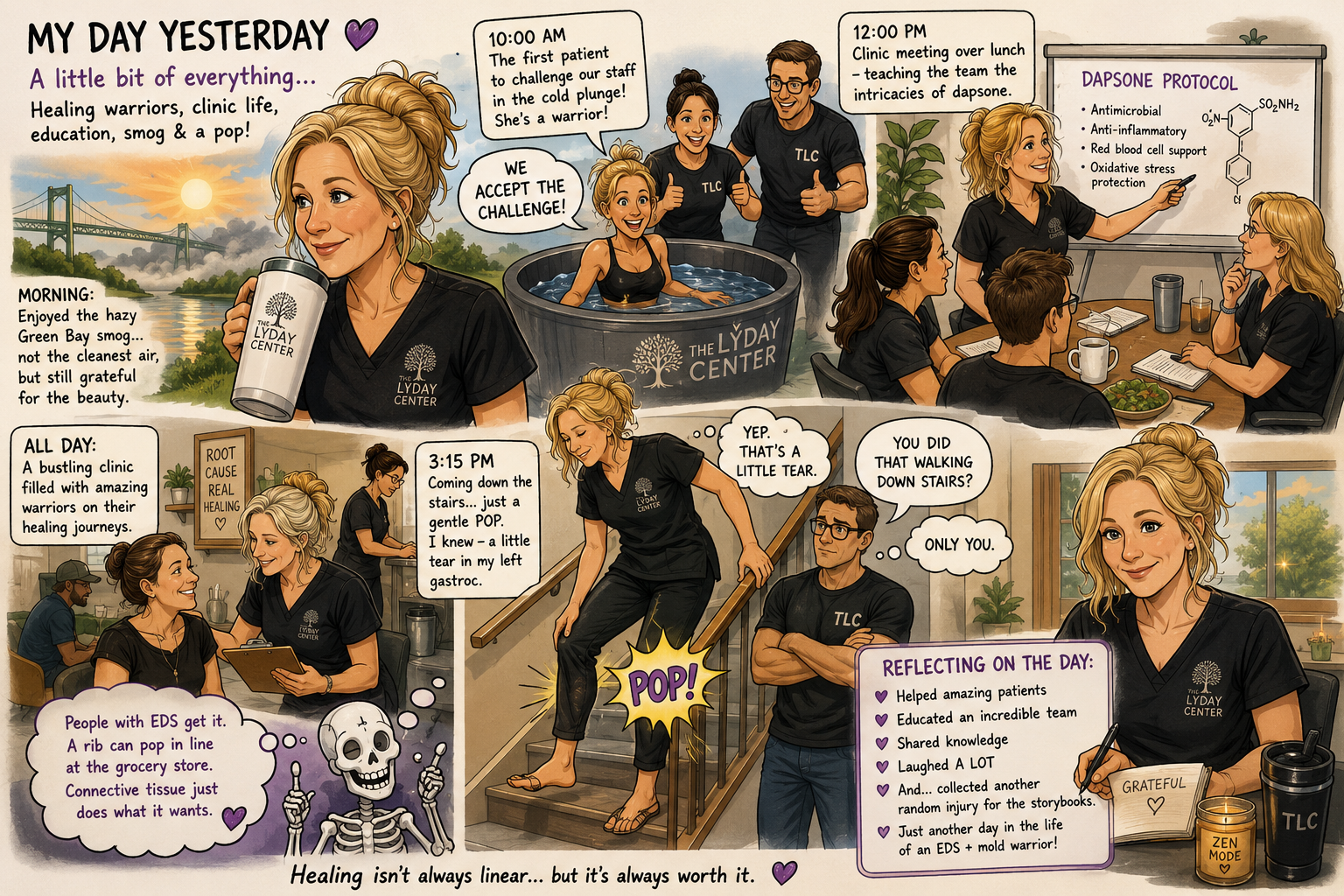
One of our favorite warriors came in for a follow-up and became the very first patient brave enough to challenge our staff in the cold plunge.
We spent lunch teaching the team the finer points of the dapsone protocol.
Clinic was bustling.
Life was good.
Then...
Walking down the stairs...
Not running.
Not exercising.
Not lifting.
Just...
Walking.
Pop.
A tiny pop in my left calf.
Immediately I looked at Gio and said,
"I think I just partially tore my gastrocnemius."
He looked at me like I'd completely lost my mind.
"How?"
"I was... walking."
The funny thing?
I knew exactly what it felt like because I did the same thing to my right calf a few years ago.
No trauma.
No dramatic sports injury.
Just...
Life.
Welcome to the world of Ehlers-Danlos Syndrome (EDS).
If you have EDS, you understand.
You can pop a rib reaching for cereal.
Throw your shoulder out putting on a jacket.
Dislocate your knee walking through Target.
Wake up with neck pain because... apparently sleeping was too aggressive.
To everyone else, it sounds ridiculous.
To you?
It's Tuesday.
So what is EDS?
Ehlers-Danlos Syndrome is a group of inherited connective tissue disorders.
Connective tissue is the body's scaffolding.
It holds together:
• Ligaments
• Tendons
• Skin
• Blood vessels
• Fascia
• Joints
• Internal organs
The most common type, hypermobile EDS (hEDS), often causes:
• Joint hypermobility
• Frequent sprains and subluxations
• Chronic pain
• Muscle injuries
• Early arthritis
• Fatigue
• Poor wound healing
• Autonomic dysfunction (POTS)
• GI issues
• Pelvic floor dysfunction
• Headaches and migraines
And many people spend years being told...
"It's just anxiety."
"It's just fibromyalgia."
"You just need to exercise."
Here's where things get really interesting...
Many of the patients I see with mold illness are also incredibly bendy.
Is mold causing EDS?
No.
EDS is genetic.
But mold may dramatically amplify what those genes look like in everyday life.
When someone is genetically predisposed to weaker connective tissue, chronic inflammation from mold exposure can make symptoms much more noticeable.
Mycotoxins increase inflammatory signaling, oxidative stress, and immune activation. They can also impair mitochondrial function and tissue repair. In people with underlying connective tissue fragility, that inflammatory burden may worsen pain, slow recovery, and contribute to feeling like the body is "falling apart." While research into this relationship is still evolving, many clinicians who treat environmentally acquired illness recognize that patients with hypermobility often have a harder time recovering from inflammatory exposures.
Many patients with hypermobility also have overlapping conditions such as:
• Mast Cell Activation Syndrome (MCAS)
• Dysautonomia/POTS
• GI dysmotility
• Chronic migraine
• Chronic fatigue
• Small fiber neuropathy
Those are many of the same conditions we commonly see in patients dealing with mold illness.
That doesn't prove one causes the other—but it does mean the overlap deserves attention.
Do you need an official diagnosis?
Patients ask me this all the time.
My answer?
Usually...
Probably not.
Unless you're pursuing disability accommodations or need documentation for a specialist, putting a formal label on it often doesn't change how I approach treatment.
What changes outcomes is addressing the pieces we can influence:
• Reducing inflammation
• Optimizing nutrition
• Supporting collagen and connective tissue health
• Calming mast cells when they're overactive
• Improving mitochondrial function
• Treating mold or tick-borne illness when present
• Strengthening rather than overstretching unstable joints
• Helping the nervous system feel safe again
We can't rewrite your genes.
But we can often improve how those genes are expressed in day-to-day life.
I joke that I won the genetic lottery...
The "mother-f***er gene."
The dreaded mold susceptibility gene.
A handful of other fascinating genetic quirks.
And probably some degree of EDS.
Do I wish I had different genetics?
Sure.
But they've also made me a better physician.
Because every strange injury...
Every unexplained symptom...
Every time someone told me, "That shouldn't happen..."
Has helped me better understand the people who walk through our doors every day.
Sometimes the things that make us different become the very things that allow us to help others.
❤️ Question for my bendy warriors...
What's the most ridiculous injury you've ever had?
Did you throw your back out sneezing?
Pop a rib reaching for a seatbelt?
Dislocate something while sleeping?
Tell me I'm not the only one who's managed to injure herself... by simply walking down the stairs.
So...What Can You Do If You're Bendy?
First, don't panic.
Having hypermobility or EDS doesn't mean you're destined to be in pain forever. It simply means your body needs a different game plan.
I tell my patients to think about it this way:
If your ligaments are naturally stretchier than average, your muscles become your body's "external ligaments."
That means our goal is to make your muscles stronger, your mitochondria healthier, your inflammation lower, and your connective tissue as resilient as possible.
1. Prioritize Strength Training Over Stretching
This surprises almost everyone.
Many people with EDS love yoga because they're naturally flexible.
Unfortunately...
Many are stretching joints that are already too loose.
Instead, focus on:
• Slow progressive strength training
• Pilates
• Physical therapy with someone familiar with hypermobility
• Core stabilization
• Glute strengthening
• Rotator cuff exercises
Think stability over flexibility.
2. Eat Enough Protein
Your body is constantly rebuilding collagen.
Aim for approximately 1.2-1.6 grams of protein per kilogram of body weight daily, or more if you're very active or recovering from injury, unless another medical condition requires a different target.
Collagen can't be built without amino acids.
3. Support Collagen Production
A few nutrients I commonly consider when someone has connective tissue fragility include:
• Hydrolyzed collagen peptides (10-20 grams daily)
• Vitamin C (essential for collagen cross-linking)
• Glycine
• Proline
• Lysine
Think of collagen peptides as providing building blocks, while vitamin C helps your body assemble them.
4. Don't Forget the Minerals
Many patients with hypermobility also have autonomic dysfunction (POTS) or muscle cramping.
Depending on the individual, optimizing:
• Magnesium
• Potassium
• Sodium (when appropriate)
• Trace minerals
can help improve muscle function and reduce cramping. The right approach depends on the person's medical history and blood pressure.
5. Calm the Inflammation
If someone is constantly inflamed from mold illness, chronic infections, or an overactive immune response...
Healing connective tissue becomes much harder.
This is why I spend so much time looking for:
• Mold exposure
• Tick-borne illness
• Mast Cell Activation Syndrome
• Gut inflammation
• Hormone imbalance
• Mitochondrial dysfunction
If you don't remove the inflammatory "brakes," the body has a much harder time repairing itself.
6. Consider Peptides (When Appropriate)
One area I'm particularly excited about is regenerative peptides.
Depending on the individual, peptides such as:
• BPC-157
• GHK-Cu
• TB-500
are being studied or used clinically to support tissue repair and recovery. While high-quality human evidence is still developing, many clinicians use them as part of a broader regenerative plan rather than a standalone treatment.
7. Optimize Hormones
Hormones matter.
Low estrogen, low testosterone, thyroid dysfunction, and cortisol imbalances can all reduce connective tissue resilience and slow healing.
Sometimes improving hormones is one of the biggest missing pieces.
8. Don't Ignore Mitochondria
Your muscles, tendons, and fascia require enormous amounts of energy to heal.
Supporting mitochondrial function may include:
• CoQ10
• Acetyl-L-carnitine
• Alpha-lipoic acid
• NAD+ support
• Magnesium
• Omega-3 fatty acids
If the "battery" isn't charged, the body can't repair itself efficiently.
The Bottom Line
You can't change your genetics.
But you can influence how those genetics are expressed.
Lower inflammation.
Build stronger muscles.
Support collagen production.
Treat underlying mold or infections when present.
Restore your mitochondria.
Balance hormones.
Give your connective tissue the raw materials it needs to heal.
That is where the magic happens.
The goal isn't to become someone else.
The goal is to build the strongest, healthiest version of your body so your genes stop writing the entire story.