Covid Changed The World…Part 3
Covid, mold illness, chronic pain, Lyme and co-infections
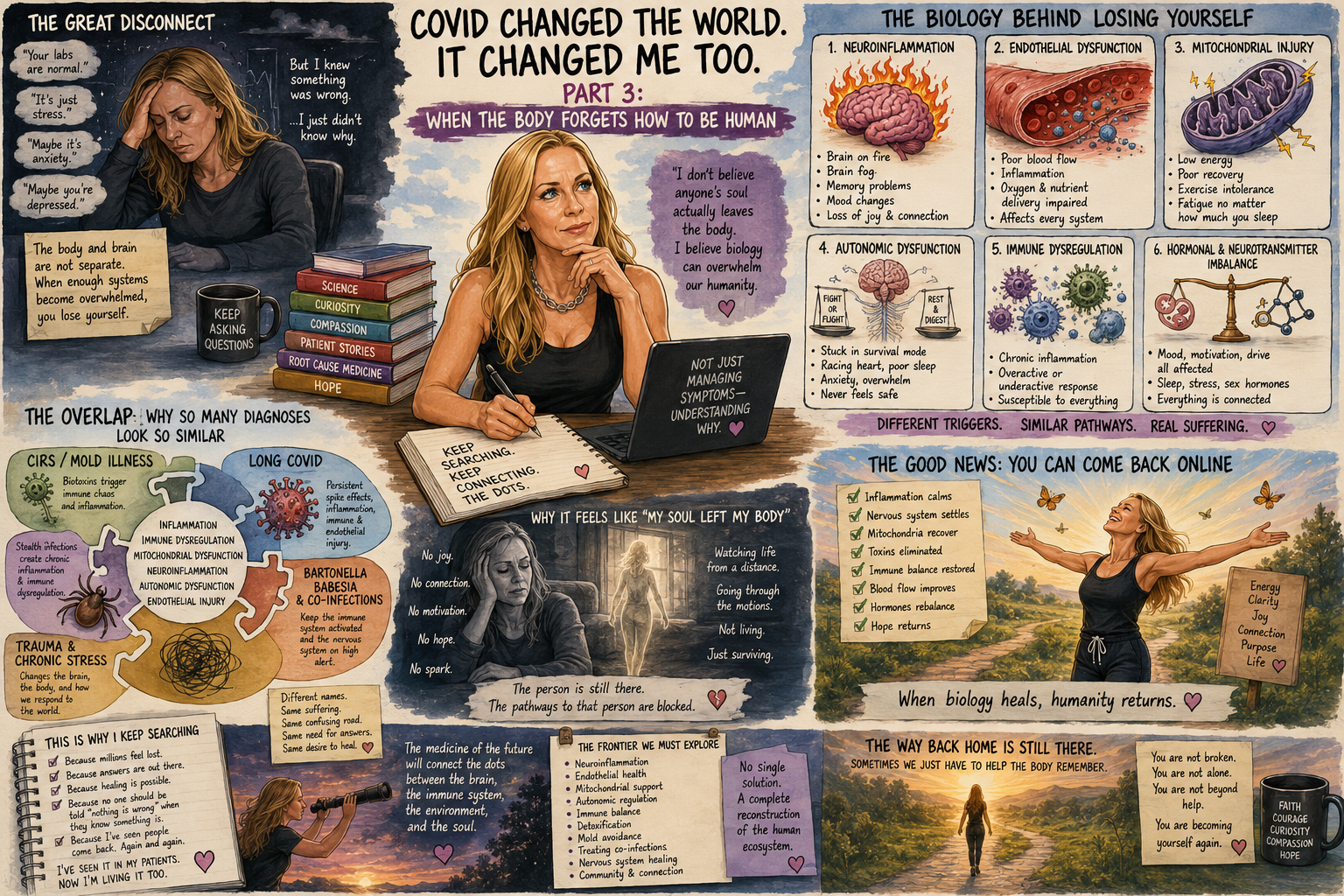
COVID Changed the World. It Changed Me Too.
Part 3: When the Body Forgets How to Be Human
One phrase keeps appearing in my clinic.
Different patients.
Different diagnoses.
Different ages.
Different backgrounds.
Yet somehow they all end up saying the same thing.
"I don't feel like myself anymore."
Some describe it as brain fog.
Some call it depression.
Some call it burnout.
Others struggle to find words at all.
They simply sit across from me and say:
"It's like my soul left my body."
As a physician, I have spent years trying to understand what that means.
Because when enough people tell you the same story, you start paying attention.
The Great Disconnect
Modern medicine has become incredibly sophisticated.
We can transplant organs.
Replace joints.
Sequence genes.
Map the human genome.
Yet many patients are still told:
"Your labs are normal."
"You're just stressed."
"Maybe it's anxiety."
"Maybe you're depressed."
And while anxiety and depression are real, I have become increasingly convinced that they are often symptoms rather than root causes.
The body and brain do not operate separately.
The immune system talks to the nervous system.
The nervous system talks to the endocrine system.
The endocrine system talks to the mitochondria.
The mitochondria talk to every cell in the body.
Everything is connected.
And when enough systems become overwhelmed, the result can feel remarkably similar to losing yourself.
The Brain on Fire
Imagine trying to run the most sophisticated computer on Earth while someone continuously pours sand into the gears.
The computer still works.
But slower.
Less efficiently.
More erratically.
That is how many patients describe neuroinflammation.
They can still think.
But not clearly.
They can still function.
But not efficiently.
They can still feel.
But not fully.
Words disappear.
Memories become harder to access.
Motivation fades.
Joy becomes muted.
Connection feels distant.
The person is still there.
But their ability to access themselves has become impaired.
For years I thought I was simply exhausted.
Looking back, I wonder if my brain was fighting a battle I couldn't see.
The Endothelium: The Organ Nobody Talks About
Most people have never heard of the endothelium.
Yet it may be one of the most important structures in the human body.
The endothelium is the thin layer of cells lining every blood vessel.
It determines how oxygen is delivered.
How nutrients reach tissues.
How inflammation is regulated.
How blood flows throughout the body.
When the endothelium is healthy, everything works better.
When it becomes dysfunctional, the consequences can be widespread.
Fatigue.
Brain fog.
Exercise intolerance.
Poor recovery.
Autonomic dysfunction.
Cardiovascular symptoms.
The challenge is that endothelial dysfunction often doesn't show up on routine testing.
Patients know something is wrong.
But standard evaluations frequently fail to identify why.
The Mitochondria: Tiny Engines, Massive Consequences
Every cell in your body contains mitochondria.
They are often called the powerhouses of the cell.
I think of them as tiny batteries.
When mitochondria function well, life feels easier.
Energy is available.
Recovery is possible.
Resilience exists.
When mitochondrial function declines, everything becomes harder.
Patients describe it perfectly.
They wake up exhausted.
Exercise wipes them out.
Work consumes all available energy.
Life becomes survival.
No matter how much they sleep, they never feel restored.
I lived that reality.
For years.
When the Autonomic Nervous System Gets Stuck
The autonomic nervous system controls the functions we don't consciously think about.
Heart rate.
Blood pressure.
Digestion.
Temperature regulation.
Sleep.
Stress responses.
In a healthy person, the autonomic nervous system shifts smoothly between activation and recovery.
In many chronically ill patients, it becomes stuck.
The body behaves as though danger is everywhere.
Even when danger is gone.
The result is a constant state of vigilance.
Constant stress signaling.
Constant survival mode.
And eventually...
Exhaustion.
Not because the person is weak.
Because their nervous system never gets permission to rest.
Why CIRS, Long COVID, Mold, Lyme, and Trauma Look So Similar
One of the most fascinating observations in my practice is how often different illnesses produce similar symptoms.
Mold illness.
Lyme disease.
Bartonella.
Babesia.
Long COVID.
Trauma.
Chronic stress.
At first glance these appear unrelated.
But when you look deeper, they often converge upon similar biological pathways.
Inflammation.
Immune dysregulation.
Autonomic dysfunction.
Endothelial injury.
Mitochondrial dysfunction.
Neuroinflammation.
The trigger may differ.
The downstream effects can look remarkably similar.
Which is why so many patients spend years collecting diagnoses while never feeling truly understood.
The labels change.
The suffering remains.
The Soul Leaving the Body
I don't believe anyone's soul actually leaves their body.
But I understand why patients say it.
When your brain is inflamed...
When your energy production collapses...
When your nervous system is trapped in survival mode...
When your body feels unsafe...
You lose access to parts of yourself.
You lose spontaneity.
You lose joy.
You lose curiosity.
You lose connection.
You lose hope.
The person remains.
But the pathways that allow them to experience life become obstructed.
What patients describe as losing their soul may simply be biology overwhelming their humanity.
The Good News
The story doesn't end there.
Because I have also witnessed the opposite.
I have watched people come back online.
I have watched patients laugh again.
Travel again.
Work again.
Dream again.
Love again.
I have watched marriages recover.
Families reconnect.
Lives rebuild.
Not because someone convinced them to think positively.
Because their biology improved.
The inflammation calmed.
The nervous system settled.
The mitochondria recovered.
The body regained its ability to heal.
And when that happened, the person reappeared.
Why I Keep Searching
This is why I continue to ask difficult questions.
Because I don't believe humanity is broken.
I believe many people are biologically overwhelmed.
I believe the epidemic of chronic illness is larger than most realize.
And I believe that understanding neuroinflammation, endothelial health, mitochondrial function, autonomic regulation, and immune balance may unlock answers for millions of people who have been told nothing is wrong.
Perhaps the greatest lesson of my own journey is this:
The goal isn't merely to survive.
The goal is to become yourself again.
And if there is one thing my patients have taught me, it is that no matter how lost a person feels...
The way back home is still there.
Sometimes we just have to help the body remember.