Covid Part Two:
#covid #chronicillnesswarrior #lymedisease #moldillness
COVID Changed the World. It Changed Me Too.
Part 2: The Search for Answers
After writing Part 1, many people will likely ask the same question:
"What do you think happened?"
The honest answer is simple.
I don't know.
Not completely.
But I know enough to keep searching.
As a physician, I have learned that the most dangerous words in medicine are often:
"We already know."
History is filled with examples of conditions that were dismissed, misunderstood, or ridiculed before science eventually caught up.
Ulcers were once blamed on stress before we discovered H. pylori.
Multiple sclerosis was once considered largely psychiatric.
Mold illness was dismissed for decades.
Lyme disease continues to generate controversy despite affecting countless lives.
Medicine evolves when someone is willing to ask uncomfortable questions.
So that's where I find myself today.
Asking questions.
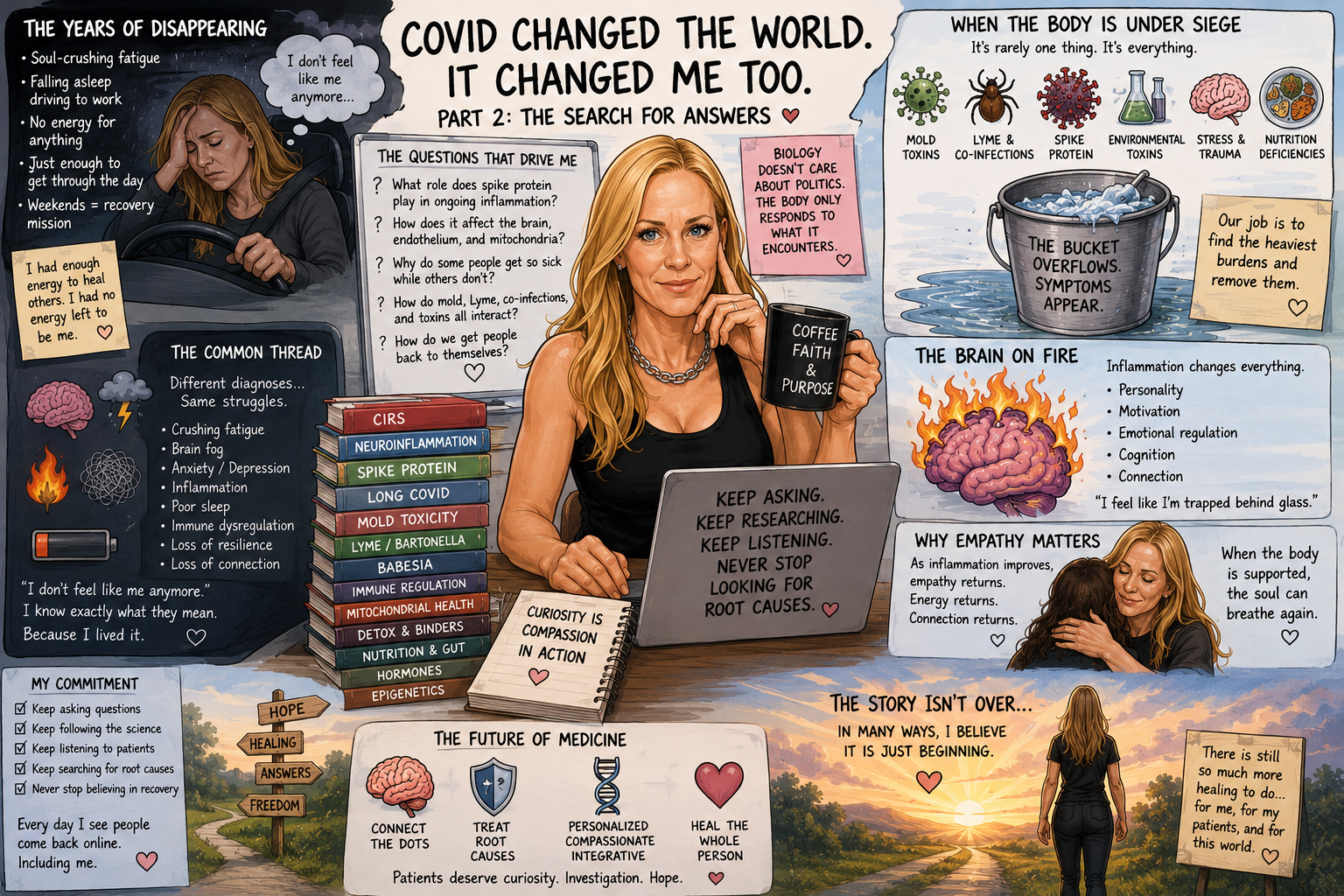
The Common Thread
Over the last several years, I have treated some of the sickest patients imaginable.
People with mold illness.
People with Lyme disease.
People with Bartonella.
People with Babesia.
People with chronic fatigue.
People with autoimmune conditions.
People with severe neurological symptoms.
People whose lives were completely destroyed by illness that conventional medicine often struggles to explain.
What fascinates me is that despite different diagnoses, many of these patients share similar symptoms:
Crushing fatigue.
Brain fog.
Anxiety.
Depression.
Loss of motivation.
Exercise intolerance.
Sleep disturbances.
Inflammation.
Hormonal dysfunction.
Immune dysregulation.
Loss of resilience.
Many describe feeling disconnected from themselves.
They often say:
"I don't feel like me anymore."
I know exactly what they mean.
Because I lived it.
When the Body Is Under Siege
One thing functional medicine has taught me is that symptoms rarely come from a single source.
The body is an ecosystem.
Rarely is there one villain.
More often there are multiple stressors overwhelming the system simultaneously.
Mold exposure.
Tick-borne infections.
Environmental toxins.
Poor sleep.
Emotional trauma.
Nutritional deficiencies.
Chronic inflammation.
Metabolic dysfunction.
And potentially viral or spike-protein-related immune activation.
Each burden alone may be manageable.
Together they can become devastating.
I often describe this as the bucket theory.
Everyone has a bucket.
Stressors fill it.
At some point the bucket overflows.
Symptoms appear.
The challenge is determining which burdens are contributing most heavily for each individual patient.
The Question of Spike Protein
This is where conversations become difficult.
The COVID pandemic introduced something unprecedented into modern society.
Nearly every human on Earth experienced exposure to either the virus itself, vaccination, or both.
As a result, questions surrounding spike protein have become emotionally charged and politically polarized.
Unfortunately, biology doesn't care about politics.
The body only responds to what it encounters.
And that means we must be willing to investigate every possibility with intellectual honesty.
What role does spike protein play in ongoing inflammation?
What role might it play in endothelial dysfunction?
What role might it play in mitochondrial health?
What role might it play in neuroinflammation?
What role might it play in susceptible individuals who already carry multiple biological burdens?
These are questions worth exploring.
Not because we have all the answers.
But because patients deserve answers.
The Brain on Fire
The more patients I treat, the more I become convinced that inflammation of the nervous system may be one of the defining health challenges of our time.
When the brain is inflamed, people don't simply experience physical symptoms.
They experience changes in personality.
Changes in motivation.
Changes in emotional regulation.
Changes in resilience.
Changes in cognition.
Changes in connection.
The person remains the same.
But their ability to access their best self becomes impaired.
Many patients describe feeling trapped behind glass.
They know who they are.
They just can't reach that version of themselves anymore.
I understand that feeling.
Because I experienced it myself.
Why Empathy Matters
Perhaps the most surprising part of my healing journey has been the return of something I didn't realize I had lost.
Ease.
Connection.
Presence.
The effortless desire to engage with people.
As my energy has improved, my capacity to connect has improved as well.
That observation raises an interesting question.
How much of what we call personality is actually biology?
When inflammation affects the brain, what happens to empathy?
What happens to motivation?
What happens to hope?
What happens to our ability to love one another?
I don't believe every societal problem can be explained biologically.
But I do believe biology influences behavior more than most people realize.
A population that is exhausted, inflamed, isolated, and chronically stressed will not behave the same way as a population that is healthy and thriving.
The Future of Medicine
I believe medicine is entering a new era.
An era where we stop separating the brain from the immune system.
An era where we stop separating mental health from physical health.
An era where we stop pretending chronic inflammation only affects the body.
The future belongs to physicians willing to connect the dots.
Not because every theory will prove correct.
But because patients deserve curiosity.
Patients deserve investigation.
Patients deserve hope.
My Commitment
My commitment remains the same as it was the day I opened The Lyday Center.
Keep asking questions.
Keep following the science.
Keep listening to patients.
Keep searching for root causes.
Keep looking for ways to help the body heal.
And most importantly—
Never stop believing that recovery is possible.
Because every day I see evidence that the body can come back online.
I see it in my patients.
And for the first time in many years, I am seeing it in myself.
The story isn't over.
In many ways, I believe it is just beginning.