
Hotel Rooms & Histamine
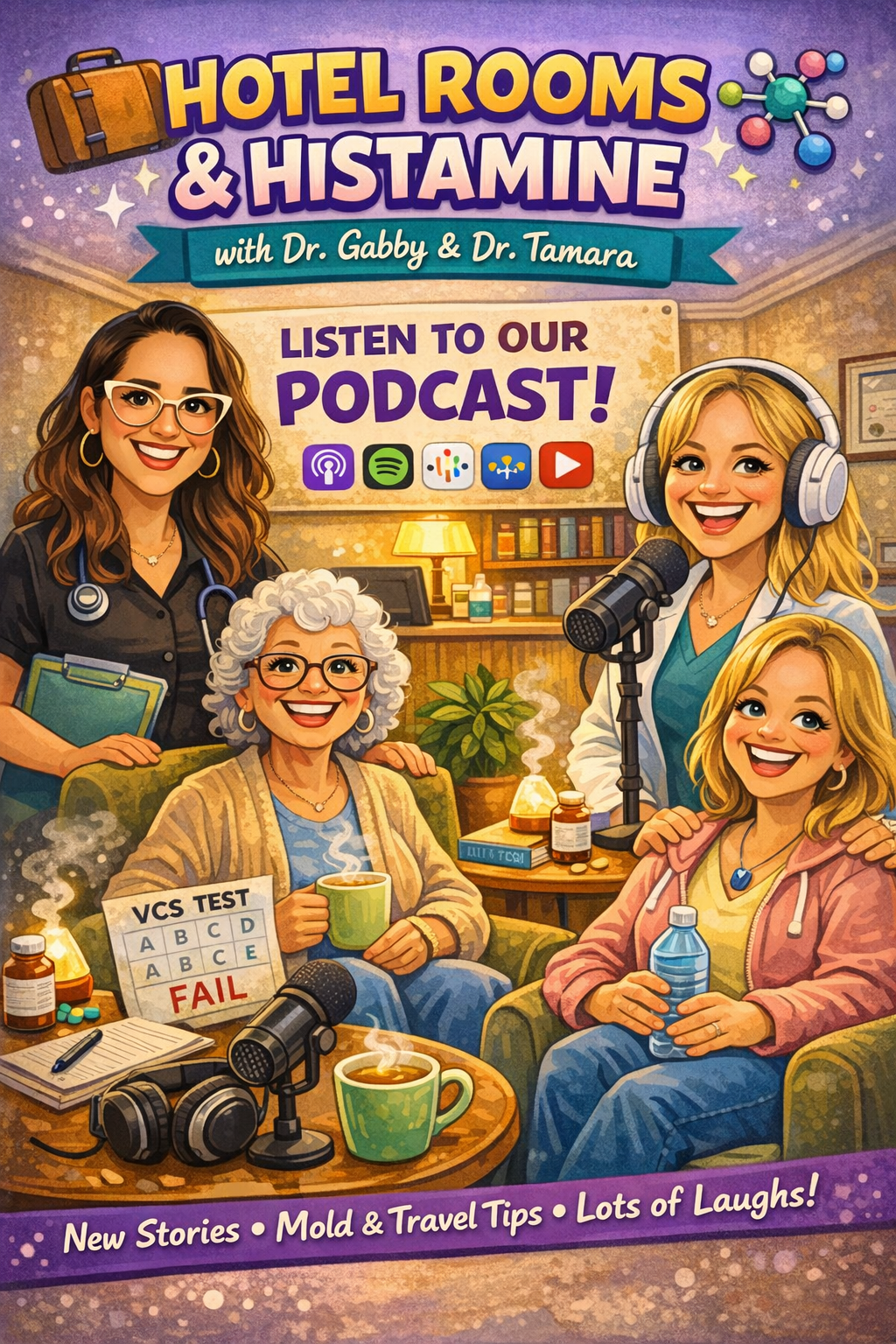
Hotel Rooms & Histamine
And the Stories That Remind Us Why Mold Still Matters
Tomorrow we release our newest podcast episode:
Hotel Rooms & Histamine: Travel Tips for Moldies
With Dr. Tamara Lyday & Dr. Gabby
On the surface, it’s an episode about travel.
But underneath, it’s about something much bigger.
It’s about how environment shapes physiology.
It’s about why symptoms flare when you leave home.
It’s about histamine, mold exposure, nervous system instability — and why some bodies simply cannot tolerate what others don’t even notice.
And today in clinic, we were reminded exactly why this conversation matters.
When the Environment Is the Trigger
In tomorrow’s episode, Dr. Gabby and I discuss:
Why hotel rooms can destabilize mold-sensitive patients
The link between mold exposure and histamine overload
Why symptoms often hit at 2–3 a.m.
Mast cells, sinus colonization, and air quality
Travel strategies for CIRS, MCAS, and Lyme patients
Because sometimes it’s not jet lag.
It’s the room.
And sometimes it’s not just travel.
It’s decades of exposure.
Patient Story #1: 82 Years of “Fibromyalgia”
Today we saw a woman who has lived with fibromyalgia for over 30 years.
She is 82.
She remembers when her health changed — after a vaccine at age 8.
Since then:
Chronic pain
Chronic fatigue
Hypothyroid symptoms
Brittle nails
Hair loss
Always cold
Sinus congestion
Environmental sensitivity
Her labs have “always been normal.”
She has lived:
On a farm with moldy hay for 26 years
In a 150-year-old stone foundation farmhouse
In homes surrounded by woods
With repeated exposure to damp environments
When she rakes leaves, she cannot breathe.
Her VCS test fails.
She has tried charcoal for years.
She could not tolerate cholestyramine.
She has narrowed her diet to lettuce and meat.
Recently, she read Toxic by Dr. Neil Nathan.
And for the first time, she allowed herself to believe:
Mold may be the root cause.
Not anxiety.
Not aging.
Not weakness.
Environment.
And today she said something powerful:
“I’m done obsessing. I just want to get better.”
Patient Story #2: When the Brain Stops Cooperating
Our second new patient is 50.
A computer programmer for 28 years.
In 2022, she forgot how to turn off the caps lock.
Then she couldn’t calculate a tip.
She forgot her wedding date.
She couldn’t sign her name.
She was treated for anxiety.
Then depression.
Then functional neurologic disorder.
MRI.
EEG.
Speech therapy.
Mental health therapy.
Hyperbaric oxygen.
PEMF.
Some improvement.
But not resolution.
She had COVID twice.
Her symptoms worsened afterward.
Eventually, testing revealed mold markers and inflammatory changes.
With binders and anti-inflammatory strategies, cognition began to return.
She tolerates exercise.
She sleeps.
She is improving.
But she lost her job.
Because no one understood what was happening.
The Common Thread
These women are decades apart in age.
Different life paths.
Different symptom timelines.
But both share:
Environmental exposure
Sinus and inflammatory burden
Nervous system dysregulation
Symptoms that never matched “normal labs”
Years of being told it was anxiety
This is why tomorrow’s episode matters.
Because for mold-sensitive individuals, environment is not neutral.
A hotel room.
A leaf pile.
A damp basement.
An old farmhouse.
These are not small exposures.
They are immune events.
Mold, Histamine, and the Nervous System
When someone with mold sensitivity walks into a moldy environment, what happens?
Mast cells activate
Histamine rises
Cytokines increase
Sinuses swell
Autonomic instability worsens
Brain fog intensifies
Sleep fractures
And sometimes it takes decades before someone connects the dots.
Tomorrow’s Episode: Practical Travel Strategies
In Hotel Rooms & Histamine, Dr. Gabby and I discuss:
How to assess a hotel room before unpacking
What to bring to reduce exposure risk
Why nighttime flares are common
How to calm mast cells while traveling
Why sinus colonization matters
The connection between mold and histamine intolerance
Because if you are mold-sensitive, travel should not feel like gambling with your health.
The Bigger Picture
We are seeing more patients who:
“Look fine”
Have normal labs
Have chronic congestion
Have thyroid symptoms that don’t show up on paper
Have cognitive shifts after environmental exposure
And they are not imagining it.
Sometimes the trigger isn’t in the psyche.
Sometimes it’s in the air.
If you’ve ever:
Felt worse after staying somewhere overnight
Had symptoms flare after travel
Noticed brain fog in damp environments
Felt dismissed because your labs were normal
This episode is for you.
Because sometimes it’s not stress.
It’s histamine.
And sometimes it’s not in your head.
It’s in the room.
Dr. Tamara Lyday, DO
The Lyday Center