
It’s More Than A Concussion…
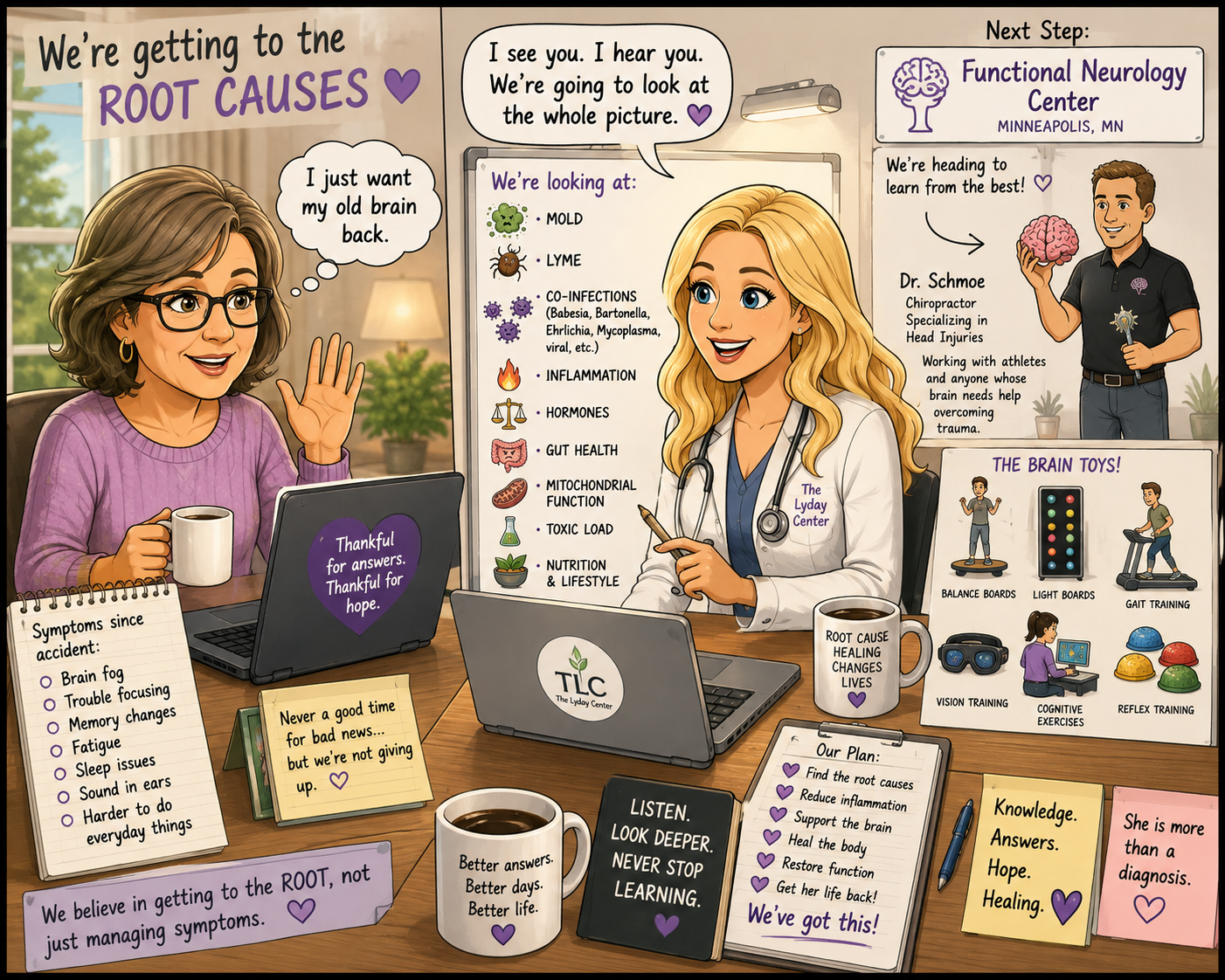
Is it dementia? Or is it a poorly treated concussion?
A Close Family Member Was Told She Had Dementia. But I Couldn't Stop Thinking About What Happened Three Years Earlier.
Around Christmas, someone I love received the kind of news nobody ever wants to hear.
Dementia.
And because she is who she is, she didn't immediately tell the family.
She thought, It's Christmas. I don't want to ruin Christmas.
So she waited.
Then there was another family event coming up, and she didn't want to cast a shadow over that either.
So she waited some more.
Finally, she realized something heartbreaking and incredibly true:
There is never a good time to tell the people you love that you've been diagnosed with dementia.
So she sent the family a message.
And when I read it, my heart sank.
But almost immediately, another thought came into my head:
Wait a minute. Something about this doesn't make sense.
Because I remembered my aunt before the accident.
And I remembered my aunt after the accident.
Those were not the same person.
Three Years Earlier, Everything Changed
She had been involved in a significant accident.
Before it, she was functioning normally.
Afterward, things were different.
Her memory wasn't the same. Her ability to concentrate wasn't the same. Things that used to come easily required tremendous effort. She became exhausted more easily. Her sleep changed. She developed hearing-related symptoms.
And most importantly, she knew something was wrong.
She didn't ignore it.
She went to the doctor.
She asked questions.
She saw specialists.
She went back.
She asked again.
She saw ENT. She saw neurology. She saw primary care. She went back to neurology.
She kept telling people:
“Something changed after that accident.”
And yet, years later, here we were talking about dementia.
That is the part that breaks my heart.
Not because I can say today that every one of her symptoms is from a concussion. I can't.
And not because a diagnosis of dementia should simply be thrown away. It shouldn't.
But because the story of what happened to her brain after that accident matters.
And she had been trying to tell people that for years.
Sometimes the Most Important Diagnostic Test Is the Story
I practiced conventional medicine for the first half of my career.
I cared deeply about my patients then, just as I do now. I always wanted to do the right thing.
But I didn't know then what I know now.
Years of additional training have taught me to look differently at complicated patients. And perhaps even more importantly, they've reinforced something I've believed for a long time:
Listen to the patient.
People live inside their bodies 24 hours a day.
When somebody looks at me and says:
“I know myself, and I have never been the same since that happened,”
my ears perk up.
That sentence matters.
A Concussion Doesn't Always Look the Way People Think It Does
You don't have to be knocked unconscious.
You don't necessarily have to have dramatic findings on a CT scan.
Sometimes the person walks away from the accident, goes home and looks relatively normal.
But afterward?
The headaches start.
Or the dizziness.
Or the fatigue.
Or the insomnia.
Or suddenly they can't concentrate through an entire conversation.
They lose words.
They can't tolerate busy environments.
Their emotions feel different.
Their memory isn't what it was.
They describe brain fog.
They start saying:
“I just want my old brain back.”
Most people with concussion recover well.
But some people continue to experience symptoms long after the original injury.
And that deserves attention.
This Is One Reason Gio and I Are Flying to Minneapolis Today
This story has hit very close to home.
So today, Gio and I are heading to Minneapolis to spend two days with Dr. Schmoe at Functional Neurology Center.
Dr. Schmoe is a chiropractor whose practice focuses on head injuries and neurologic rehabilitation, including working with athletes who have experienced repeated head impacts.
And I'm excited to learn.
Not because I believe any one person has a magical answer.
Not because every case of memory loss is secretly a concussion.
And certainly not because I think we should abandon neurologists, neuropsychologists, imaging, rehabilitation medicine or appropriate dementia evaluations.
I'm going because I want more tools.
I want to understand how another clinician evaluates the person sitting across from him saying:
“I haven't been myself since I hit my head.”
I want to see what he looks for.
I want to understand his approach.
I want to bring the useful pieces of what I learn back home.
Because that's what I believe medicine should be.
Never stop learning.
And Yes—I'm Going to Fight for My Loved One - And All of YOU
When someone you love is struggling, it's impossible to make it completely academic.
I want my loved one better.
I want answers.
I want to know which parts of what she is experiencing may be treatable.
I want to know whether we're dealing with persistent effects of a traumatic brain injury, a neurodegenerative process, sleep problems, hearing problems, metabolic issues—or several things layered together.
Most importantly, I don't want the word “dementia” to become the end of the conversation.
It should be the beginning of another set of questions.
If You've Been in an Accident, Please Hear Me
If you hit your head—or your body was hit hard enough that your brain was violently accelerated and decelerated—get evaluated.
Especially if something feels wrong afterward.
And if you develop a worsening headache, repeated vomiting, seizure, weakness, slurred speech, increasing confusion, severe drowsiness or other significant neurologic changes, that is emergency-care territory.
But here's the other piece people forget:
Pay attention to yourself afterward.
A month later.
Three months later.
A year later.
Are you back to yourself?
Can you think the way you used to?
Can you work the way you used to?
Can you exercise?
Can you sleep?
Can you tolerate light, noise and busy environments?
Are headaches, dizziness or fatigue now part of your everyday life?
Does your spouse keep saying, “You've been different since the accident”?
Don't dismiss those observations.
And don't assume that because your initial imaging was reassuring, every persistent symptom must therefore be unrelated.
Protect Your Future Brain
We are learning more and more about the consequences of repetitive head impacts, particularly in people who spend years playing collision sports or sustaining repeated head trauma.
That does not mean one concussion equals dementia, Parkinson's, ALS or another neurodegenerative disease.
But it gives us another reason to take brain injuries seriously rather than shrugging them off.
Your brain is you.
It's your memories.
Your personality.
Your ability to work.
Your ability to laugh at a joke, remember a birthday, drive a car, read a book, recognize the person you love and walk into a room knowing exactly why you went there.
It's worth protecting.
So We're Off to Minneapolis
Two days of learning.
Two days of asking questions.
Two days of looking at brains differently.
And, yes, one very determined niece who isn't ready to accept that the only thing left to do is watch someone she loves decline.
I don't know exactly what we're going to learn yet.
That's the point.
Medicine should leave room for curiosity.
I will share more after Gio and I get back from Functional Neurology Center and tell you what we learned from Dr. Schmoe—what intrigued me, what the evidence supports, and what I think may actually be useful for our patients.
And if my aunt's story makes even one person who has never felt right after an accident stop and say,
“Wait. Maybe I need to have this evaluated again,”
then she and I will both be over the moon.
Sometimes the most important thing we can do for a patient is believe them when they say:
“I know my body. Something changed.”
And then care enough to keep asking why.