Rewiring the Brain
Functional neurology, POTS, Dysautonomia
Rewiring the Brain: Our Journey into Functional Neurology
What if the concussion you had decades ago is still influencing how your brain functions today?
Yesterday was one of those days that reminds me why I will forever be a student of medicine.
There is always another layer.
Another piece of the puzzle.
Another way to help our warriors heal.
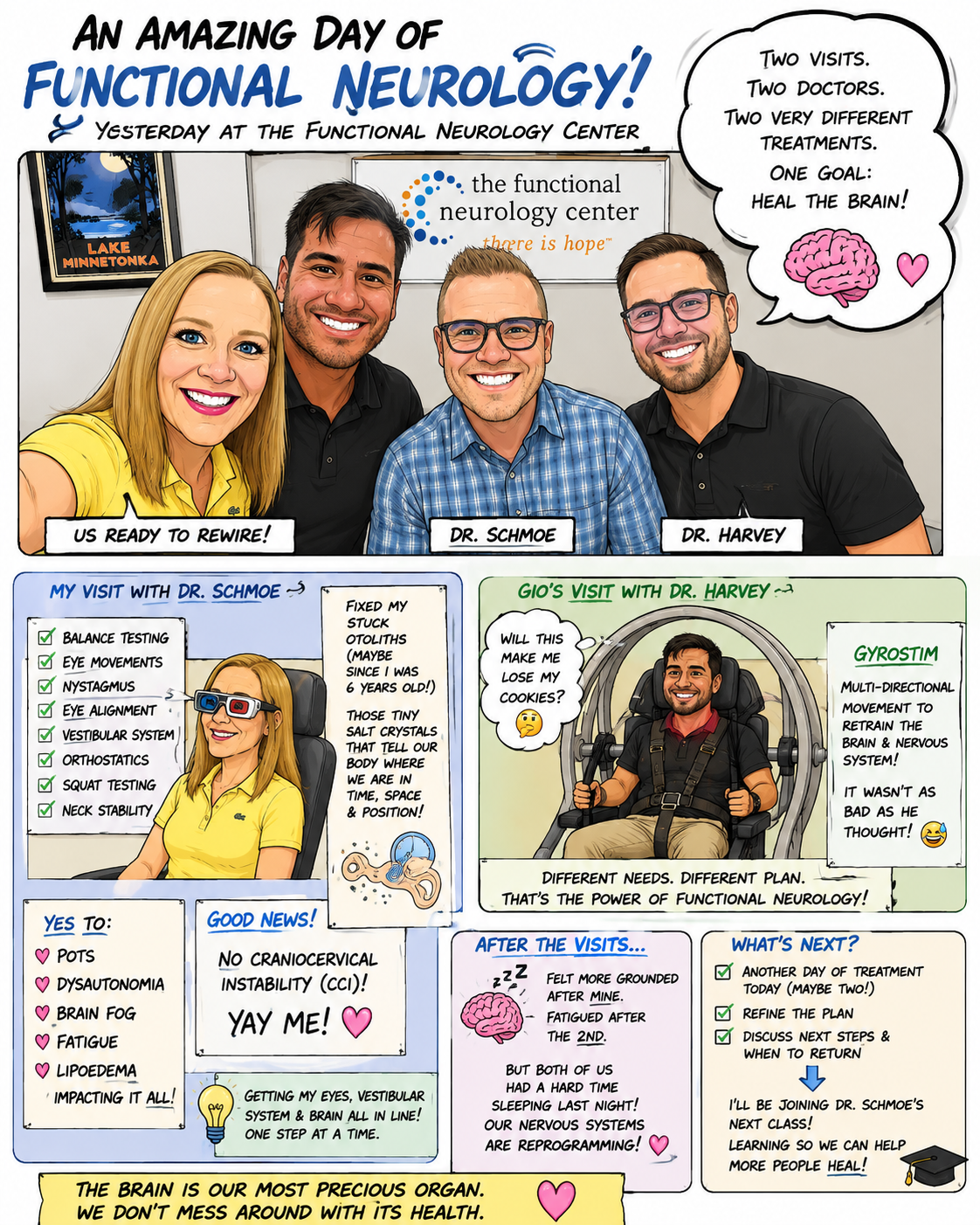
Gio and I spent the day immersed in the world of functional neurology at the Functional Neurology Center, working with Dr. Schmoe, Dr. Harvey, and their incredible team. What I thought would be a straightforward evaluation turned into one of the most fascinating experiences I've had in years.
Two visits.
Two very different treatment plans.
Two very different brains.
And that's exactly the point.
No Two Brains Are the Same
Although Gio and I walked through the same doors, our evaluations and treatments couldn't have been more different.
That's one of the things I immediately appreciated.
Functional neurology isn't about finding a diagnosis and handing everyone the same protocol.
It's about figuring out which parts of your nervous system are functioning well... and which parts need help reconnecting.
My Brain Has Been Through a Lot...
As Dr. Schmoe walked me through a comprehensive neurologic examination, I started mentally replaying all the head injuries I've had throughout my life.
There have been more than I can count, but a few stand out.
The first happened around age six.
A "friend" pushed me off one of those giant concrete playground tunnels.
I landed squarely on my face.
Looking back now, I wonder how much changed in that single moment. Interestingly, my menstrual cycle began not long after that injury, and it has always made me wonder whether that trauma may have influenced my neuroendocrine system. I can't say with certainty that the two are connected, but it's certainly something that crossed my mind as I reflected on my history.
Years later...
There was the deer.
Driving much too fast on my way to my medical board examinations, I struck a deer and the airbags exploded into my face.
Then came another concussion after I unexpectedly passed out during a medical conference and landed face-first onto a concrete floor.
Most recently...
I managed to collide with concrete stairs in my old office while turning around on the staircase.
Not exactly one of my finer moments.
There have been other bumps along the way...
But those are the ones I remember most.
As someone who spends every day talking to patients about brain health, inflammation, and longevity...
I also know the association between repeated head trauma and later cognitive decline.
If there is an opportunity to improve brain function today...
Why would I wait?
Testing Beyond the Ordinary
This wasn't your typical neurologic examination.
Dr. Schmoe evaluated:
My balance
Eye movements
Eye alignment
Nystagmus
Vestibular function
Neck stability
Orthostatic responses
Squat testing
Autonomic nervous system function
Every test told another part of the story.
One of the most fascinating discoveries involved my otoliths.
Those Tiny Salt Crystals Matter...
Inside our inner ears live microscopic calcium carbonate crystals called otoliths.
Think of them as tiny GPS sensors.
They help your brain understand:
Where your head is in space
Which direction you're moving
Whether you're accelerating or slowing down
How to maintain balance
When they aren't functioning normally—or become displaced—they can contribute to dizziness, imbalance, and conditions like benign paroxysmal positional vertigo (BPPV).
Dr. Schmoe performed maneuvers designed to reposition and normalize my vestibular system.
As I lay there, I couldn't help but wonder...
Could some of these abnormalities have been present since that playground injury decades ago?
There's no way to know for certain.
But it's remarkable to think that the nervous system can adapt to old injuries for years—and that sometimes it simply needs the right input to recalibrate.
The Dysautonomia Puzzle
None of this exists in isolation.
Do I have POTS?
Absolutely.
Do I have dysautonomia?
Without question.
Could my lipedema be contributing?
Absolutely.
When Dr. Schmoe performed my orthostatic testing—and then repeated it while squatting—the changes were striking.
One possible explanation is that compression of blood vessels in the lower extremities can alter blood return to the heart. When circulation changes, the autonomic nervous system has to work harder to maintain blood flow to the brain.
Suddenly...
Fatigue.
Brain fog.
Lightheadedness.
They all fit into a much larger neurologic picture.
The Best News of the Day
After evaluating my neck...
Dr. Schmoe smiled.
"No craniocervical instability."
I may have done a little internal happy dance.
For someone who seems to collect diagnoses...
It was refreshing to hear that something wasn't wrong.
We'll take the wins where we can get them.
Meanwhile...
Across the clinic...
Gio was having a completely different experience.
He underwent many of the same assessments but ended up in something called the GyroStim.
If you know Gio...
You'll appreciate this.
Before the appointment, he was absolutely convinced that climbing into a machine designed to rotate him in multiple directions was going to make him "lose his cookies."
Spoiler alert...
He survived.
Apparently his nervous system was ready for a different level of therapy than mine.
While he was working in the penthouse...
I was still rewiring the basement.
And that's exactly how it should be.
Treatment should match the person sitting in front of you—not the diagnosis on the chart.
Then Something Unexpected Happened...
After my first treatment...
I felt...
Grounded.
Calm.
Present.
After the second session...
I crashed.
Not in a bad way.
Just profoundly fatigued.
Almost as if my brain had spent the day doing the neurological equivalent of running a marathon.
Then came bedtime.
Neither Gio nor I could sleep.
Our brains felt...busy.
Almost like they were trying to process and integrate everything they had experienced during the day.
Whether that reflects neurologic adaptation, excitement, or simply the novelty of the experience, I don't know.
But it was fascinating that we both noticed it.
Why Functional Neurology Matters
One of the things I admire most about Dr. Schmoe is that he isn't just treating patients.
He's teaching.
This weekend, practitioners from around the country will gather to learn these techniques from him and his team.
That matters.
Because proper concussion rehabilitation is something I believe is often underrecognized. Many people are told to "rest until you feel better," but persistent symptoms can involve complex interactions among vision, balance, vestibular function, the autonomic nervous system, and other brain networks. Functional neurology aims to assess those systems and, when appropriate, use targeted rehabilitation strategies to improve function.
The more clinicians who understand the brain...
The more patients we can help.
What's Next?
Today we return for another day of treatment.
Perhaps two sessions.
We'll continue mapping my nervous system, refining the plan, and discussing what comes next—including when we should return for additional care.
As for me...
I've already decided.
The next time Dr. Schmoe teaches this material...
I'll be in the classroom.
Because if understanding the brain allows me to help one more patient reclaim their life...
It's worth every minute.
The Biggest Lesson
Your brain remembers every story your body has lived.
Sometimes it compensates beautifully.
Sometimes it struggles quietly.
And sometimes...
It simply needs someone who knows how to help it find its way back.
The brain is our most precious organ.
It deserves the same attention we give our heart.
Our hormones.
Our gut.
Because everything begins there.
Yesterday reminded me that healing isn't always about adding another supplement or medication.
Sometimes...
It's about giving the brain the right information so it can do what it was designed to do all along.
Heal.