
The Farmer Who Couldn’t Feel…
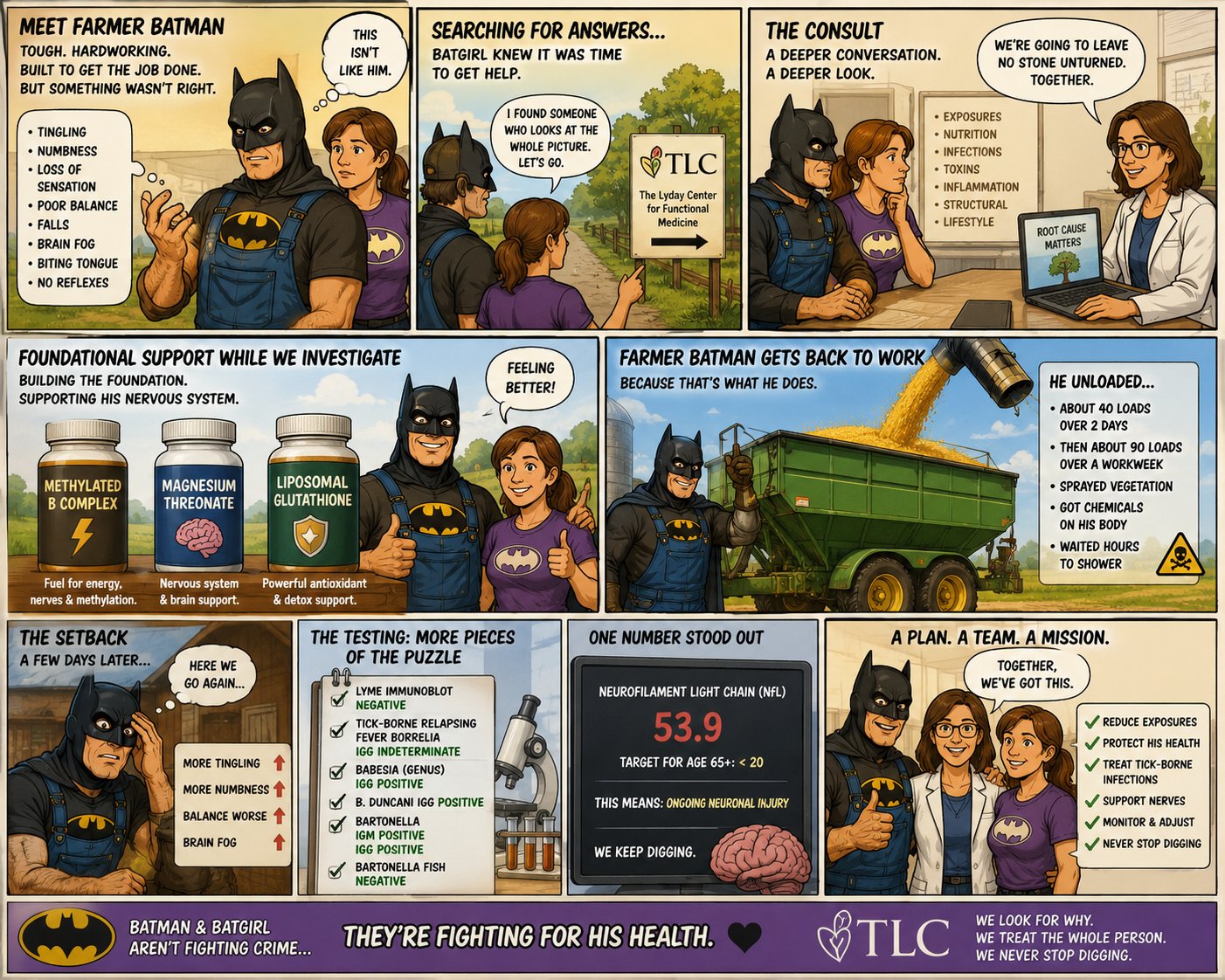
Parkinson’s, ALS, MS, Farming side effects
THE FARMER WHO COULDN’T FEEL WHAT WAS IN HIS POCKETS
A Warrior Story About Neuropathy, Farming, Hidden Exposures—and Why Sometimes We Don’t Wait
There are certain patients who walk into my office and immediately make the hair on the back of my neck stand up.
Not because they look sick.
Sometimes it is exactly the opposite.
They are the people who have spent their entire lives working.
Fixing things.
Lifting things.
Growing things.
Taking care of everyone else.
They don't complain. They don't slow down. And they certainly don't run to the doctor every time something hurts.
This particular warrior is a farmer.
And if you've spent any time around farmers, you probably already know the type.
Something hurts?
Keep working.
Don't feel well?
Keep working.
Moldy corn?
Move it.
Something breaks?
Fix it.
Chemicals need spraying?
Get it done.
Which is exactly why his story matters.
Because by the time someone like this says,
"Something isn't right."
I listen.
It Started With His Hands
He came to me through a referral from someone I had cared for years ago during my family-practice days.
That patient had recently found his way back to me after discovering his diabetes had gotten frighteningly out of control.
His response when discussing where he wanted to go for help was about as farmer as it gets:
"I will only see Lyday."
😂
That referral eventually brought another farmer through my door.
And this man's story was different.
His fingers had started tingling.
Then the tingling became constant.
Then his feet joined the party.
Eventually, it wasn't simply tingling anymore.
He was losing sensation.
He could put his hands into his pockets and feel that something was there—but couldn't reliably tell whether he was touching his keys or his ChapStick.
His reflexes had disappeared.
His balance had deteriorated.
He had fallen.
He was sometimes biting his tongue while eating.
He had lost some of the normal awareness of where his body was in space—what we call proprioception.
He had brain fog.
And the symptoms involved both sides of his body.
This was no longer:
"My fingers feel funny."
This was:
"Why isn't this nervous system communicating normally anymore?"
And THAT is a question I take very seriously.
These Were Neurologic Red Flags
Loss of sensation.
Loss of proprioception.
Absent reflexes.
Balance changes.
Falls.
Fine sensory discrimination disappearing.
These symptoms don't automatically mean Parkinson's disease, multiple sclerosis, ALS, Lyme disease—or any single diagnosis.
But they absolutely deserve a careful neurologic workup.
Peripheral neuropathy can have many causes, including diabetes, vitamin deficiencies or toxicities, autoimmune disease, spinal disease, medications, toxins and infections. Neurologic Lyme disease can also involve the peripheral nerves and cause numbness, tingling, pain and weakness. (CDC)
And there was another piece of his history that I couldn't ignore.
He is a farmer.
We Need to Talk About Farmers
I have tremendous respect for the farming community.
But there is an occupational-health conversation that doesn't happen nearly enough.
Farmers can experience repeated exposure to:
pesticides
herbicides
fungicides
solvents and fuels
machinery grease and petroleum products
grain dust
mold and mycotoxins
contaminated organic material
ticks and other vectors
And sometimes that happens with far less respiratory and skin protection than I would like.
This isn't about blaming agriculture.
It is about understanding cumulative exposure.
Research has repeatedly associated pesticide exposure with increased risk of Parkinson's disease. One large prospective study reported a 70% higher incidence of Parkinson's among people reporting pesticide exposure, although observational research cannot prove that pesticides caused an individual's disease. (PubMed)
The concern isn't limited to Parkinson's.
A recent systematic review and meta-analysis found occupational pesticide exposure associated with increased ALS risk, with greater risk estimates among those reporting higher exposure. Earlier systematic reviews have also found increased ALS risk associated with farming and agricultural pesticide exposure. (PubMed)
And a systematic review of occupational risk factors for MS reported associations with both agricultural work and pesticide exposure, while emphasizing the need for further research. (PubMed Central (PMC))
That does not mean:
Farmer + pesticides = Parkinson's/MS/ALS.
It means that when a farmer with years of occupational exposure walks into my office with progressive neurologic symptoms, I am not comfortable shrugging my shoulders and calling it aging.
I want to know WHY.
Then I Asked About Ticks
Of course I did.
We live in Wisconsin.
😂
Had he had ticks on him?
Oh yes.
Over the years, plenty.
Did he remember a classic bull's-eye rash?
No.
Did he meticulously inspect himself every night after working outside?
Also no.
He remembered ticks crawling around his neck in the spring for years.
And that history mattered to me.
Because infections transmitted by ticks can produce neurologic manifestations, and Lyme can involve peripheral nerves. (CDC)
So Lyme and co-infections went onto my differential.
Not because every neurologic symptom is Lyme.
Not because a tick crawling on someone proves infection.
But because you cannot appropriately investigate a complicated neurologic case without looking at the exposures that actually occurred in that person's life.
And this man's life had been spent outdoors.
There Was Another Exposure Hiding in Plain Sight
Mold.
He had worked around moldy corn.
He remembered going into a bin containing moldy grain and later feeling so lousy that he would go home, put on sweats, sweat profusely, shower and change his clothes.
His home had also experienced repeated basement water intrusion over the years.
Now my differential was getting interesting.
Was this metabolic?
Nutritional?
Toxic?
Infectious?
Inflammatory?
Structural?
Environmental?
Several of the above?
That's the work.
Functional medicine isn't about deciding beforehand that everything is mold or Lyme.
It is about asking:
What has happened to this human being over the last 60+ years that could explain what I'm seeing today?
I Didn't Want to Wait for Every Result
We ordered the deeper investigation.
But there was something else I decided that day.
I didn't want him sitting at home doing absolutely nothing while we waited.
His nervous system was already telling us it was struggling.
So I started three foundational supports:
1. Methylated B Complex
B vitamins are integral to neurologic function, methylation and cellular energy metabolism.
His later testing also showed elevated homocysteine, which can be a clue that methylation pathways deserve attention.
I wanted to support the biochemical machinery his body uses every single day.
2. Magnesium Threonate
Magnesium participates in hundreds of enzymatic reactions and is critical for normal nerve and muscle function.
I chose magnesium threonate because I specifically wanted a magnesium strategy oriented toward nervous-system support.
3. Liposomal Glutathione
And then there was glutathione.
Glutathione is one of our major endogenous antioxidant defense systems.
For a patient with a lifetime of environmental and occupational exposures, supporting antioxidant capacity while we investigated the bigger picture made sense to me.
These weren't being used as a "cure" for neuropathy.
They were the foundation while we figured out why the neuropathy was happening.
And then something happened that made this case even more interesting.
He Came Back Better
At his follow-up, he and his wife told me something I wasn't expecting to hear quite so dramatically.
His sensation had substantially improved.
He could tell what was in his pockets again.
His balance was better.
He wasn't bouncing into the wall when getting out of bed.
The abnormal sensation involving his tongue was gone.
He still had some residual symptoms in his palms and heels, but compared with where he started?
This farmer was doing better.
That did not prove what caused the neuropathy.
And it didn't prove that three supplements had "treated" an underlying disease.
But clinically?
It was information.
His nervous system appeared capable of changing.
And then Farmer Batman did what Farmer Batman does.
He went farming.
🤦♀️
Enter: 40 Loads of Corn
He loaded approximately 40 loads of corn over two days.
Then came another stretch involving approximately 90 loads over the course of a workweek.
And around that same period?
More chemical exposure.
He had sprayed vegetation and gotten agricultural chemical on his body.
Instead of immediately stopping and washing it off...
he finished what he was doing.
And waited hours before showering.
Because farmer.
🤦♀️🤦♀️🤦♀️
A few days after those exposures, he noticed something.
The symptoms started creeping back.
Not all the way.
But enough that he noticed.
And so did I.
Does that prove that mold or agricultural chemicals caused the flare?
No.
But the timing made his occupational exposures even more important to investigate—and gave us a very practical intervention regardless:
We needed to dramatically reduce unnecessary exposure.
Gloves.
Appropriate protective clothing.
Proper respiratory protection for the product or environment.
Following pesticide labels and re-entry requirements.
Washing exposed skin promptly.
Changing contaminated clothing.
And not treating PPE as something only "other farmers" need.
Batman still needs armor.
Then the Testing Came Back
This was the part I had been waiting for.
His standard Lyme immunoblots themselves were negative.
But when we looked beyond Lyme alone, additional tick-borne findings appeared.
His testing showed an indeterminate IgG result for tick-borne relapsing fever Borrelia, rather than a definitive positive.
His Babesia testing showed positive IgG at the genus level, including B. duncani IgG positivity, while Babesia FISH and IgM were negative.
And his Bartonella testing demonstrated positive IgM and IgG immunoblot findings, including species-level antibody reactivity, while Bartonella FISH was negative.
Those results have to be interpreted alongside symptoms, exposure history and the rest of the clinical picture. Antibody positivity is not synonymous with proving that every current symptom is caused by active infection.
But suddenly we had more pieces to investigate.
And One Number Made Me Pay Even Closer Attention
We had also checked a newer marker called neurofilament light chain—or NfL.
Think of NfL as a marker that can rise when neurons are being injured.
It isn't a Parkinson's test.
It isn't an ALS test.
It isn't an MS test.
It does not tell us why nerve injury is occurring.
But his value was 53.9.
For someone over 65, the functional target used in our lab interpretation was below 20.
That got my attention.
Because now I wasn't simply listening to someone describe numb feet.
I had a patient with significant neurologic symptoms and an objective biomarker suggesting ongoing neuronal injury.
That is exactly the type of situation where I want to keep digging—and where conventional neurologic evaluation remains important.
Why We Chose to Treat the Tick-Borne Piece
After reviewing his entire clinical picture, exposure history and testing, we elected to begin a closely monitored dapsone-based protocol targeting the suspected tick-borne disease component.
Dapsone isn't a vitamin.
It isn't something I casually hand someone because a Lyme test looks interesting.
It can cause serious adverse effects—including hemolysis, methemoglobinemia and blood-count abnormalities—and requires appropriate screening and laboratory monitoring.
We specifically checked his G6PD level before treatment, because G6PD deficiency increases the danger of oxidative injury to red blood cells with medications such as dapsone. His level was documented as normal on our testing.
And we will be following this warrior carefully.
Because this isn't about attacking one lab result.
It's about reducing the total burden on a nervous system that has been waving a giant red flag.
The Bigger Lesson
I don't know exactly where this man's story will end.
That's why I'm going to keep sharing it.
But I know what I don't want.
I don't want to see him several years from now with dramatically progressive neurologic disease and wonder:
Were there clues years earlier that we could have investigated?
Because there were clues.
His hands were telling us.
His feet were telling us.
His balance was telling us.
His reflexes were telling us.
His exposure history was telling us.
And eventually, his laboratory investigation started giving us additional pieces.
I cannot promise that identifying environmental exposures, nutritional problems or infections will prevent Parkinson's, MS, ALS or another neurodegenerative disease.
Nobody ethically can.
But I absolutely believe that progressive neurologic symptoms deserve an aggressive search for potentially modifiable contributors rather than simply waiting to see what diagnosis eventually declares itself.
And Then There Is Batgirl
Every Batman needs one.
His wife came with him.
His advocate.
His cheerleader.
His protector.
And—possibly most importantly—the woman willing to tell a stubborn farmer:
"GO WASH THE CHEMICALS OFF YOUR BODY."
😂😂😂
She asks questions.
She pays attention.
She pushes him.
And she is completely invested in getting her husband back.
So around here, they've officially become:
Batman & Batgirl. 🦇
Batman may occasionally require supervision when operating farm equipment, entering questionable grain environments, or deciding whether several hours is an appropriate amount of time to marinate in agricultural chemicals.
Batgirl is on it.
And TLC?
We're going to keep digging.
TO BE CONTINUED...
This is only Chapter One.
Our warrior has started the next phase.
We're going to follow his neurologic symptoms.
His sensation.
His balance.
His inflammatory and neurologic markers.
His environmental exposures.
His response to treatment.
And we're going to see where this story takes us.
Because sometimes the most important moment in a patient's story isn't when someone finally gives the disease a name.
It's the moment somebody notices the warning signs and starts asking WHY.
Stay tuned for The Adventures of Farmer Batman & Batgirl.
I have a feeling these two are going to give us quite a story. 🦇❤️
Patient details have been intentionally changed, generalized, or omitted to protect privacy. This case is shared for education with appropriate authorization and is not intended to establish that any exposure, infection, supplement, or treatment caused or cured a particular neurologic condition. Progressive numbness, weakness, loss of balance, falls, or other new neurologic symptoms warrant appropriate medical/neurologic evaluation. Dapsone-based therapy is prescription treatment requiring individualized assessment and laboratory monitoring.