
My 2 Current Favorite Tests…And Why?
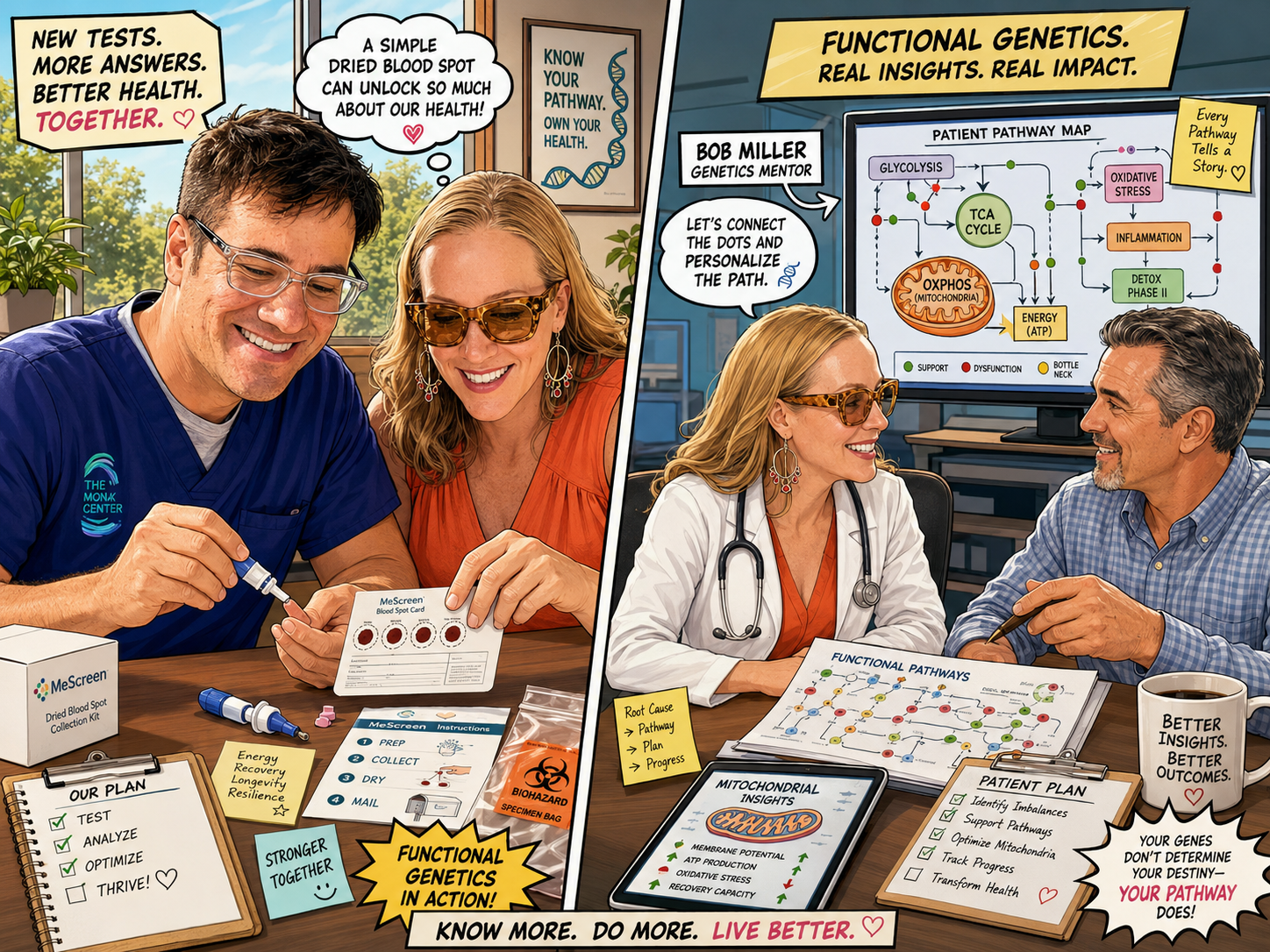
MeScreen, Functional Genomic Analysis, mitochondrial function
The Two Tests I’m Most Excited About Right Now: Functional Genomics + Mitochondrial Testing
There are moments in medicine when a new tool drops into your world and suddenly you think:
Ohhhhh. This explains so much.
Not everything.
Not magically.
Not in a “one test answers all questions forever” kind of way.
But in the way that makes a complex patient finally start to make sense.
Right now, my two favorite testing modalities are:
Bob Miller’s Functional Genomic Analysis
and
MeScreen mitochondrial testing
And I am genuinely excited about both of them.
Because for years, we have been looking at mold, Lyme, Bartonella, Babesia, long COVID, spike protein, MCAS, chemical sensitivity, fatigue, brain fog, hormone chaos, detox problems, and nervous system collapse...
But many times we were still asking:
Why does this patient get stuck?
Why does one person tolerate binders and another person crumbles?
Why does one patient thrive on methylation support and another feels like they drank rocket fuel?
Why does one person clear mold after six months while another is still circling the drain three years later?
Why does someone do “all the right things” and still not move?
That is where these tests are changing the conversation for us at TLC.
Test #1: Functional Genomic Analysis
Most people have heard of genetic testing by now.
23andMe.
Ancestry.
MTHFR.
COMT.
Maybe a nutrigenomics report that spits out a list of “take this supplement because you have this SNP.”
That is not what I am talking about.
Bob Miller’s Functional Genomic Analysis is different because it is not simply asking:
What genes do you have?
It is asking:
How might your genes be functioning together in real biochemical pathways under stress?
That distinction matters.
Functional Genomic Analysis describes its approach as using raw genetic data to help health professionals look at the interaction between functional genetic variations, environmental toxins, presenting symptoms, and labs. It is specifically framed as a support tool for function rather than a disease-predisposition or diagnostic test. (Functional Genomic Analysis)
And that is exactly why I love it.
Because I do not need another test telling me someone is “at risk.”
I need to know:
Where are their bottlenecks?
Where is inflammation getting amplified?
Where is detox struggling?
Where are antioxidants not regenerating?
Where is methylation overactive or underactive?
Where is histamine being pushed?
Where is glutamate getting loud?
Where is NAD/NADPH being stolen?
Where is mitochondrial function vulnerable?
Where is the body burning through reserves faster than we can rebuild them?
This is not “your genes are your destiny.”
Quite the opposite.
This is:
Your genes are the terrain. Your environment is the weather. Your symptoms are the storm report.
And now we can start reading the map.
Why This Matters for Mold, Lyme, and Spike Patients
At TLC, we work with some of the most sensitive patients imaginable.
Patients who cannot tolerate one drop of a binder.
Patients who herx from looking at a bottle of antifungals.
Patients who get wired from B vitamins.
Patients who flare from glutathione.
Patients who try to detox and end up in bed.
Patients who tell me, “Doc, I swear I’m doing everything, but nothing is moving.”
For those warriors, functional genomics can be a game changer.
Not because it diagnoses mold illness.
Not because it diagnoses Lyme.
Not because it tells us whether spike protein is present.
But because it helps us understand why their body may be reacting the way it reacts.
For example, if a patient has pathway patterns suggesting trouble with oxidative stress, glutathione recycling, NRF2/KEAP1 signaling, NADPH demand, sulfur handling, histamine, heme, or inflammatory signaling, suddenly their “weird reactions” are not so weird anymore.
They are biochemical.
They are predictable.
And if they are predictable, we can work with them.
Bob Miller’s teaching and certification framework includes pathway areas such as NRF2/KEAP1, NADH/NADPH/NAD+, glutathione, SOD/catalase, and other functional biochemical systems, which is exactly the type of framework that helps clinicians think beyond single-SNP medicine. (NutriGenetic Research Institute)
This matters because mold, Lyme, Bartonella, Babesia, post-viral illness, and environmental toxins all increase physiologic demand.
They ask more of the detox system.
More of the immune system.
More of the antioxidant system.
More of the mitochondria.
More of the nervous system.
So the question becomes:
Can this person’s terrain handle the demand?
If the answer is no, we stop trying to bully the body.
We start supporting the pathway.
How This Changes Treatment
This is where I get excited.
Because functional genomic analysis helps us stop guessing.
Instead of throwing a giant protocol at a sensitive patient and hoping they survive it, we can begin to ask:
Do we need to calm inflammation first?
Do we need to support antioxidant recycling before detox?
Do we need to stabilize membranes?
Do we need to go slower with methylation?
Do we need to support mitochondria before pushing antimicrobial therapy?
Do we need to focus on histamine before mold binders?
Do we need to open drainage before killing anything?
Do we need to stop “detoxing” and start rebuilding?
This is personalized medicine at a deeper level.
Not personalized because it says your name on the front of the report.
Personalized because it helps explain how your body is wired to respond under stress.
That is why this test is so useful in the background of mold, Lyme, and spike-related illness.
It does not replace the clinical picture.
It does not replace labs.
It does not replace history.
It gives us the operating manual we wish the body came with.
Test #2: MeScreen Mitochondrial Testing
Now let’s talk about the second test I am obsessed with:
MeScreen.
This is a blood spot test that gives us a functional look at mitochondrial health.
And if you have been around me for more than five minutes, you know mitochondria are one of my favorite topics.
Mitochondria are the energy-producing organelles inside most of our cells. They are often called the “powerhouses” of the cell because they produce most of the energy our cells use to function. The NIH describes mitochondria as being found in almost every human cell and producing about 90% of the energy cells need. (National Institutes of Health)
Tiny correction because I am a nerd and I love precision:
We often hear the number 37 trillion, but that refers to the estimated number of human cells in the body, not the number of mitochondria. A widely cited estimate places the total adult human cell count at about 3.72 x 10¹³, or roughly 37.2 trillion cells. (PubMed)
Most cells have mitochondria.
Mature red blood cells are the exception because they lose their nuclei and mitochondria during maturation, which is why they rely on glycolysis for energy production. (ASH Publications)
But the big point remains:
If the mitochondria are not working, the body cannot heal efficiently.
Why Mitochondria Matter So Much
Mitochondria are not just about “energy.”
They are involved in:
ATP production
Inflammation signaling
Oxidative stress
Immune function
Cell danger response
Hormone signaling
Detoxification capacity
Brain function
Muscle recovery
Aging
Resilience
There is a growing body of research connecting mitochondrial dysfunction to chronic disease, aging, metabolic disease, cardiovascular disease, neurodegeneration, and post-viral syndromes. A review in Endocrine Reviews describes mitochondrial damage as a major contributing factor in multiple noncommunicable chronic diseases including cardiovascular disease, cancer, obesity, insulin resistance, and type 2 diabetes. (PubMed Central (PMC))
NIH also notes that mitochondrial malfunction is being studied in conditions such as diabetes, heart disease, liver disease, dementia, ME/CFS, and long COVID. (National Institutes of Health)
So when a patient says:
“I’m exhausted.”
“I can’t recover.”
“My brain won’t work.”
“I crash after doing normal things.”
“I feel like my battery never charges.”
I am thinking:
What are the mitochondria doing?
And now we have a way to follow that more directly.
What MeScreen Shows Us
MeScreen is not a diagnostic test for a specific disease.
It is not meant to diagnose mitochondrial disease, chronic fatigue syndrome, long COVID, Lyme disease, or mold illness.
It is a functional wellness assessment that provides mitochondrial-energy context.
According to MeScreen’s own materials, the test uses an at-home dried blood spot sample, laboratory analysis, and a digital report that includes a MeScore and 11 core functional metrics. The company is clear that the test is designed to provide mitochondrial function context, not to diagnose disease or replace medical care. (MeScreen UK) (MeScreen UK)
And that is exactly how we plan to use it.
Not as a diagnosis.
As a trend marker.
A way to ask:
Are the mitochondria improving?
Is cellular energy coming up?
Is treatment actually rebuilding the engine?
Are we pushing too hard?
Is the patient’s physiology becoming more resilient?
Are our interventions translating into better energy production?
This is the part that makes me really excited clinically.
Because when someone has chronic fatigue, long COVID, mold illness, Lyme, MCAS, or post-exertional malaise, we can talk about mitochondria all day long.
But I want to watch them rebound.
I want to see the engine come back online.
Why We’ll Be Checking It Quarterly
My plan is to use MeScreen as a quarterly marker in the patients where it makes sense.
Not everyone needs everything.
But for the patients who are stuck, depleted, unable to recover, or trying to rebuild after years of inflammation, I want to know what the mitochondria are doing over time.
Every three months, we can ask:
Is the energy system improving?
Are the interventions working?
Do we need more mitochondrial support?
Do we need to slow down detox?
Do we need more nervous system regulation?
Do we need to address infections more aggressively?
Do we need to stop killing things and start feeding the engine?
Because the goal is not simply to lower mold numbers.
The goal is not simply to suppress infections.
The goal is not simply to get labs in range.
The goal is to help the body produce enough energy to heal.
The Two Tests Together Are Even Better
This is where the magic happens.
Functional Genomic Analysis tells us:
Where might the pathways be genetically vulnerable?
MeScreen tells us:
How is the energy system functioning right now?
One is the blueprint.
The other is the fuel gauge.
One helps us understand tendencies.
The other helps us track function.
One helps explain why a patient is sensitive.
The other helps us see whether they are rebuilding.
This is why I am so excited to use them together in our most complex patients.
Because when someone has mold, Lyme, spike-related illness, chronic inflammation, and nervous system dysregulation, they usually do not have one problem.
They have a tangled web.
Functional genomics helps us untangle the web.
MeScreen helps us see whether the spider is finally getting less tired.
Okay, maybe that analogy got weird.
But you get the point.
Teaser: Gio and I Tested Too
Because of course we did.
You know we test everything on ourselves first.
Gio and I both got our MeScreen results back this week.
And surprise, surprise...
We are both low.
Shocking, I know.
The two people running a healing center, doing apheresis, recovering from chronic illness, chasing toxin numbers, trying to work, travel, love, build, heal, and occasionally pretend we are normal...
Have low mitochondria.
No wonder our Friday night plans look like:
Red light.
Massage.
Maybe a sauna.
Maybe asleep by 8:47.
No more dancing on tables at the club.
Honestly, the club was never ready for us anyway.
But Here’s the Hope
Low mitochondria do not scare me.
They give me a target.
They tell me where to aim.
They tell me why the recovery has felt slower than I wanted.
They tell me why we need to keep rebuilding from the ground up.
And they remind me that healing is not just about removing the bad stuff.
It is about restoring the system that gives the body power.
That is the part I never want patients to forget.
You are not lazy.
You are not weak.
You are not dramatic.
You may simply be running on a cellular battery that has been drained by infection, toxins, inflammation, trauma, stress, surgery, poor sleep, or years of pushing through.
And if we can measure it, we can support it.
If we can support it, we can track it.
If we can track it, we can celebrate the rebound.
The Future of Functional Medicine
This is where I think medicine is going.
Not just “What diagnosis do you have?”
But:
What is your terrain?
What are your vulnerabilities?
What are your mitochondria doing?
What is your inflammatory load?
What is your toxin burden?
What is your nervous system state?
What is your body capable of tolerating right now?
And what order do we need to address things so that healing actually happens?
Because for our sensitive warriors, order matters.
Pace matters.
Support matters.
Data matters.
And hope matters.
At TLC, we are not interested in throwing generic protocols at complicated humans.
We are interested in understanding the human in front of us.
Their genetics.
Their mitochondria.
Their exposures.
Their infections.
Their story.
Their capacity.
Their resilience.
Their next right step.
That is why I am so excited about Functional Genomic Analysis and MeScreen.
They do not replace clinical judgment.
They sharpen it.
They do not replace listening to the patient.
They help explain what the patient has been trying to tell us all along.
And for the warriors who feel like nothing is moving?
These tools may finally show us where the real bottleneck is.
So yes...
We will be using them.
We will be tracking them.
We will be learning from them.
And if Gio and I are any indication, we will be starting with our own sleepy little mitochondria and cheering them back to life one red light session at a time.