
What Is Normal?
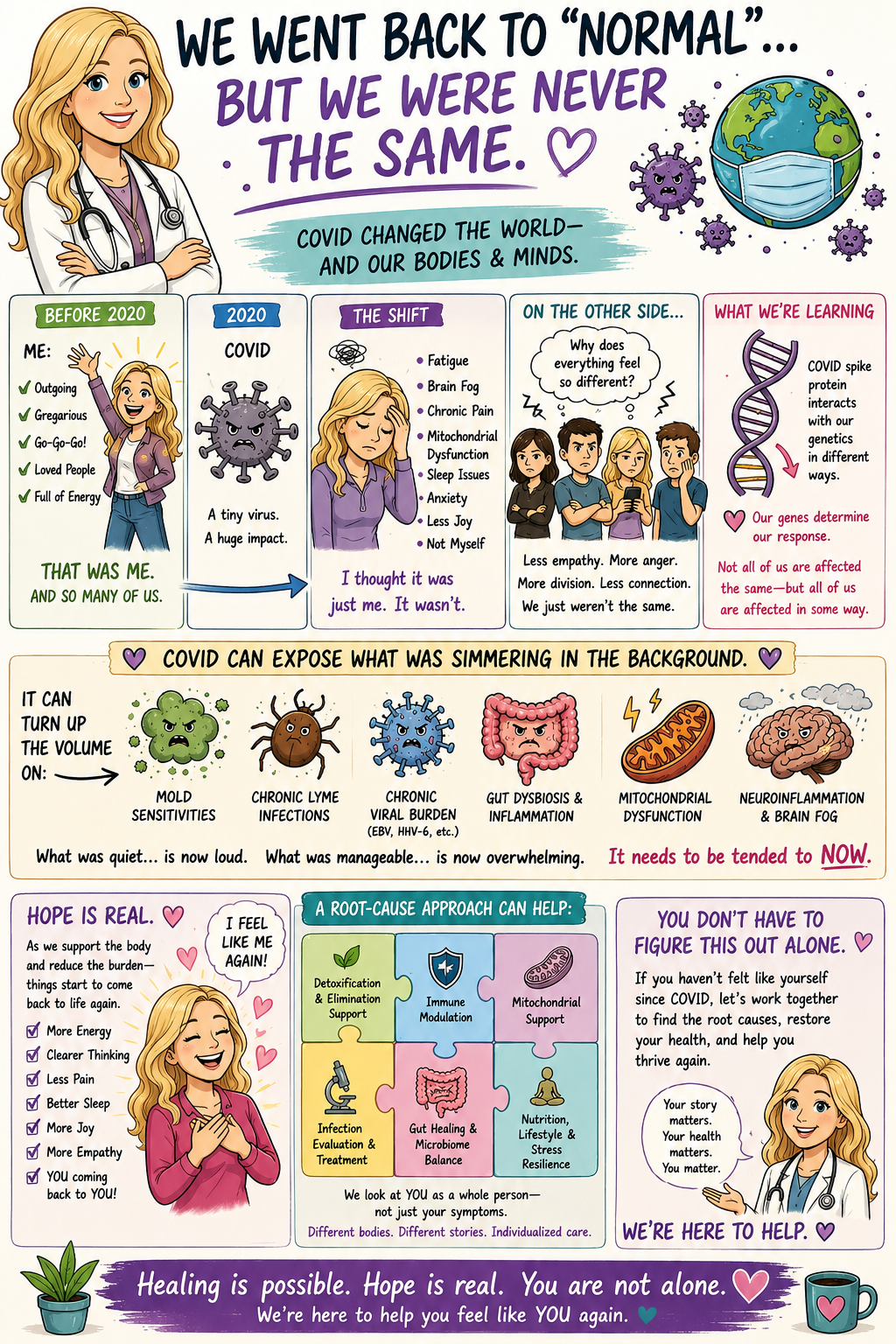
Long Haul Covid, Lyme and co-infections, Mold illness
We Went Back to Normal. But Did We Ever Really Feel Normal Again?
Something changed in 2020.
Yes, the world changed socially. We isolated. We argued. We became afraid of one another. Families disagreed, communities divided, and medicine itself became part of an enormous cultural battle.
But for many people, something also changed physically.
Patients who had always been energetic began saying, “I just don't have the energy I used to have.”
People who had always been sharp began describing brain fog, poor memory, difficulty finding words, headaches, strange heart-rate changes, exercise intolerance, disrupted sleep and pain they had never experienced before.
Some noticed old health problems suddenly becoming louder.
And I understand that experience personally.
I had always been an outgoing, energetic, go-go-go person who loved being around people. After my COVID vaccination, I experienced a major change in my own health: significant fatigue, brain fog, chronic pain and a profound decrease in my previous stamina.
For a long time, I wondered whether it was just me.
Then our clinic began hearing variations of the same story again and again.
COVID Taught Us Something Important About the Human Body
SARS-CoV-2 does not affect everyone the same way.
Our genetics, sex, underlying health, immune history, previous infections, metabolic health and environmental exposures all influence the way our bodies respond to illness.
We now recognize Long COVID as a legitimate multisystem illness. Patients may experience persistent fatigue, brain fog, post-exertional crashes, pain, sleep disturbance, dizziness, palpitations, gastrointestinal symptoms, anxiety, depression and many other symptoms long after an infection has passed.
Researchers are investigating several potential mechanisms, including persistent viral material in some tissues, immune dysregulation, autonomic nervous-system dysfunction, vascular inflammation, mitochondrial and metabolic changes, neuroinflammation and changes in the microbiome.
In other words, for some people, the infection ends—but the body's response does not immediately return to its previous baseline.
What About the Brain—and Why Do We Feel Different?
Many of us have also noticed something harder to describe.
People seem exhausted. Less patient. Less socially connected. More anxious. More irritable. Sometimes less emotionally available.
It would be too simplistic to blame this entirely on a virus.
We lived through isolation, grief, fear, political polarization, financial stress and enormous disruption of normal human connection.
But biology may contribute for some individuals as well.
Long COVID can involve cognitive dysfunction, sleep disruption, autonomic dysfunction, depression, anxiety, fatigue and neuroinflammatory pathways. When a person's brain and body are operating under chronic physiologic stress, it is reasonable that motivation, emotional bandwidth and social engagement may feel different.
That is very different from saying COVID has genetically removed our empathy.
It means we need to take both the biology and the human experience seriously.
COVID Can Also Expose What Was Already Under the Surface
One of the most interesting observations in post-infectious medicine is that a major infection can sometimes bring previously quiet problems to the foreground.
Research has found associations between Long COVID and reactivation of latent viruses such as Epstein-Barr virus in some patients.
More broadly, chronic symptoms after infections are not unique to COVID. Similar post-infectious syndromes can occur after Epstein-Barr virus, Lyme disease and other infections.
That doesn't mean every patient with Long COVID has “reactivated Lyme,” mold illness, EBV or another hidden infection.
It means that when someone has not recovered, we should look deeper rather than dismissing them.
There Is No One-Size-Fits-All “COVID Detox”
I think this distinction is important.
We currently do not have a scientifically validated protocol that universally “detoxes spike protein,” nor is there evidence that every person needs one.
What we can do is evaluate what changed in your body.
That may mean looking at:
fatigue and post-exertional intolerance
autonomic dysfunction or POTS-type symptoms
sleep
thyroid and metabolic function
nutritional deficiencies
inflammation
cardiovascular symptoms
neurologic symptoms
gastrointestinal health
medication effects
appropriate testing for infections or reactivation when the history supports it
environmental exposures when clinically relevant
Then we build treatment around the abnormalities that are actually present.
Maybe the Goal Isn't to Go Back to 2019
Maybe the lesson of the last several years is that medicine cannot always stop at:
“Your basic labs are normal.”
People know when their bodies have changed.
If you have been saying:
“I haven't felt like myself since COVID.”
“My energy never came back.”
“My brain doesn't work like it used to.”
“Something that was manageable before suddenly exploded afterward.”
That deserves an evaluation.
Not fear.
Not a predetermined diagnosis.
And not a universal detox protocol.
It deserves curiosity, careful history-taking and a systematic attempt to understand what changed in your particular physiology.
If you have never felt fully like yourself again since COVID—or you experienced a major health change temporally associated with vaccination—we are available to help evaluate the whole picture and determine what deserves further investigation.
You may not need more guessing. You may need someone willing to ask better questions.