What’s New At TLC THIS Week…
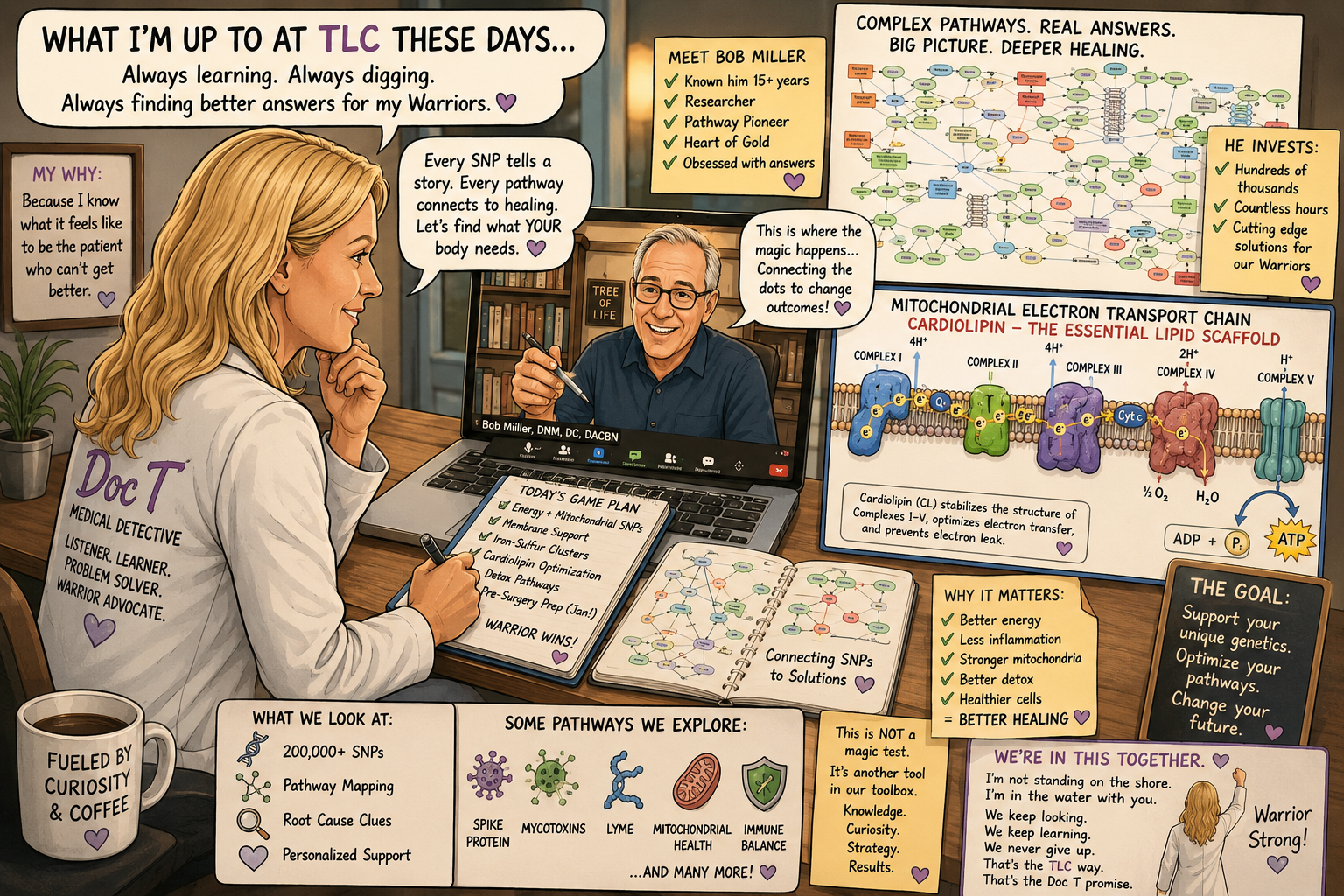
Spending my down time learning from Bob Miller #tol #moldwarrior
So…What Am I Up to at TLC These Days? 🧬
If you know me, you already know the answer:
LEARNING.
Always learning.
Always digging.
Always asking, “What are we missing?”
Because if there is something new that might help me better understand my warriors, you can pretty much guarantee I'm going to disappear down that rabbit hole.
And my latest rabbit hole?
GENETICS.
Not the “you have blue eyes and don't like cilantro” kind of genetics.
I'm talking about looking at the thousands upon thousands of tiny genetic variations—called SNPs—that help make each of us biologically different.
And this story actually started about 15 years ago.
Meet My Friend Bob Miller
I met Bob when I was brand-new to functional medicine.
We were at a conference, I heard him speak, and—as I tend to do when something fascinates me—I immediately thought:
I NEED THIS. DO ME. 😂
So I had Bob analyze my genetics.
And I'll tell you exactly what happened:
It went approximately 9,000 feet over my head.
I was still learning functional medicine. I was trying to understand methylation, detoxification, mitochondria, oxidative stress, inflammation and all of these interconnected pathways.
And Bob was already building these incredibly complicated maps showing how one pathway fed into another…and another…and another.
My brain basically said:
“That's fascinating, Bob. I understand approximately 4% of what you just said.”
😂
So life moved on.
Except Bob didn't stop.
While the Rest of Us Were Sleeping…Bob Kept Building
Over the years, I would see him at conferences.
There was Bob.
Presenting.
Researching.
Building another pathway.
Connecting another biochemical dot.
He has poured an extraordinary amount of his own time, energy and resources into developing these maps.
And recently I took another look.
HOLY. COW.
What I remembered from 15 years ago had blossomed into something enormous.
And this time?
I was ready to understand more of it.
Not ALL of it, mind you.
Bob's brain still makes my brain hurt. 😂
But enough that I could finally see why this might become another useful layer in how I think about complex patients.
Why Do SNPs Matter?
A SNP—pronounced “snip”—is a variation at a single location in our DNA.
We all have them.
Having a SNP doesn't automatically mean something is “wrong” with you.
But some genetic variants can influence how certain biological processes function—everything from nutrient metabolism to enzyme activity, medication metabolism and disease susceptibility.
The really interesting question is:
What happens when we stop looking at one SNP in isolation and start looking at patterns across pathways?
That's what has me fascinated.
Instead of saying:
“You have this SNP, therefore you need this supplement,”
I'm interested in asking:
“Does your genetic pattern give us another clue about why YOUR body responds the way it does?”
Why does one patient tolerate something beautifully while another can't?
Why does one person's mitochondrial system seem remarkably resilient while another person's energy production seems to fall apart under stress?
Why can two people experience similar environmental exposures or infections and have completely different outcomes?
Genetics may be one piece of that puzzle.
And you know how I feel about puzzle pieces. 🔎
So Guess Who Became My Guinea Pig?
Obviously...
ME. 😂
Bob and I have been spending time digging through my own data.
And right now we're particularly interested in pathways related to:
⚡ Energy production
⚡ Mitochondrial function
⚡ Oxidative stress
⚡ Cell membranes
⚡ Nutrient metabolism
⚡ Inflammatory signaling
Why membranes?
Because I'm preparing for my first lipedema surgery in January, and I'm interested in understanding everything reasonably possible about my own biology before surgery.
Lipedema appears to have a genetic component, but we're nowhere near having one “lipedema gene” that explains everyone.
That makes this particularly interesting to me.
What vulnerabilities does my biology have?
Which findings are meaningful?
Which are just interesting genetic trivia?
And are there reasonable, low-risk things we can optimize based on my actual labs, symptoms, nutrition and genetics together?
THAT is what I want to learn.
And Then Bob Showed Me Another Map…
This one immediately caught my attention.
He's developed pathway maps exploring genetic variants involved in biological systems potentially relevant to how people respond to different physiologic stressors—including infection, inflammation and environmental exposures.
For someone who spends her days seeing complicated patients dealing with things like Lyme disease, post-infectious illness and environmental exposures...
You can imagine my reaction.
“BOB. WE NEED TO TALK.” 😂
Now, an important distinction:
A genetic pathway map cannot tell me that mold, Lyme or COVID-related illness is definitely causing someone's symptoms.
It also doesn't mean that because someone carries a particular SNP, they are destined to become sick.
Genes are not destiny.
But genetics may help us generate better questions.
And better questions are where medical detective work begins.
So I've Been Spending My Weekends With Bob
Pretty much every weekend lately, I have had at least one session with him.
Sometimes we're analyzing me.
Sometimes we're looking at one of my early adopters who volunteered to let us learn from their data.
And every single time I finish, I think:
Okay. I understand more than I did last week.
Followed immediately by:
Dear Lord, I still have so much to learn. 😂
And that's okay.
Because I don't want to pretend I'm an expert in something I've just started deeply studying.
I want to become excellent at it.
That means learning.
Questioning.
Cross-referencing.
Looking at actual laboratory findings.
Looking at symptoms.
Looking at medications.
Looking at history.
And asking whether a genetic finding actually changes anything meaningful for that individual.
This Is Where Tree of Life Comes In 🧬🌳
The platform we're exploring is Tree of Life.
The genetic data allow us to examine a large number of SNPs and then organize those findings into biological pathways rather than staring at a giant meaningless list of letters.
And THAT is the part I'm excited about.
Because eventually I don't want to simply tell my warriors:
“Here are your SNPs.”
Who cares?
I want to ask:
“What, if anything, can we DO with this information?”
Can it help us identify something worth confirming with conventional laboratory testing?
Can it explain why we've repeatedly seen an unusual response?
Can it help us make nutrition or supplementation more thoughtful?
Can it identify something that warrants evaluation by a genetic counselor or another specialist?
Or does a particular finding simply go into the category of:
Interesting—but not clinically actionable yet.
That distinction matters.
This Is NOT a Magic DNA Test
I want to be very clear about this because precision medicine is exciting—and excitement can get way ahead of science.
This test does not diagnose every chronic illness.
It doesn't tell us your inevitable future.
It doesn't prove why you became sick.
And it cannot currently generate a scientifically proven “perfect supplement” based solely on your SNPs.
Some gene-nutrient relationships are well established. Others are promising. Others remain largely theoretical.
So we're going to treat genetics the same way I try to treat every new tool at TLC:
Curious. Excited. But appropriately skeptical.
Your genetics become another layer.
Genetics + symptoms + history + exposures + medications + nutrition + conventional labs + specialty testing when appropriate.
THAT is where I think this becomes interesting.
Because My Warriors Are Not Protocols
You are not:
“Mold patient #47.”
You aren't:
“Lyme protocol, page 3.”
And you're definitely not:
“Take these 17 supplements because everybody else does.”
You are biologically unique.
The dream of precision medicine is to understand enough of those differences that we can become more thoughtful about what we recommend—and equally thoughtful about what we don't recommend.
That's what I'm chasing.
So What Am I Doing at TLC These Days?
Still treating.
Still learning.
Still being my own guinea pig.
Still preparing this body for January.
Still spending my weekends getting schooled by Bob Miller. 😂
And slowly adding another set of tools to the medical detective toolbox.
🧬 Genetics.
⚡ Mitochondria.
🧠 Biochemical pathways.
🌳 Tree of Life.
🔎 And one ridiculously curious Doc T.
Will genetics turn out to be the missing piece for every warrior?
Absolutely not.
But could understanding someone's genetic vulnerabilities eventually help us make certain parts of their care more individualized?
That's exactly what I'm exploring.
And as usual, my warriors get to come along for the ride.
Because when I find something worth knowing...
you KNOW I'm going to share it with you.
Stay tuned.
This rabbit hole is getting VERY interesting. 🧬🐇
Dr. Tami Lyday, MS, DO
The Lyday Center
#PrecisionMedicine #Genetics #Nutrigenomics #FunctionalMedicine #MedicalDetective #MitochondrialHealth #Lipedema #ChronicIllness #PersonalizedMedicine #RootCauseMedicine #SNPs #GeneticTesting #EnvironmentalMedicine #LymeDisease #MoldIllness #HealingJourney #NeverStopLearning #TheLydayCenter #DocT