
Why The Gaslighting?
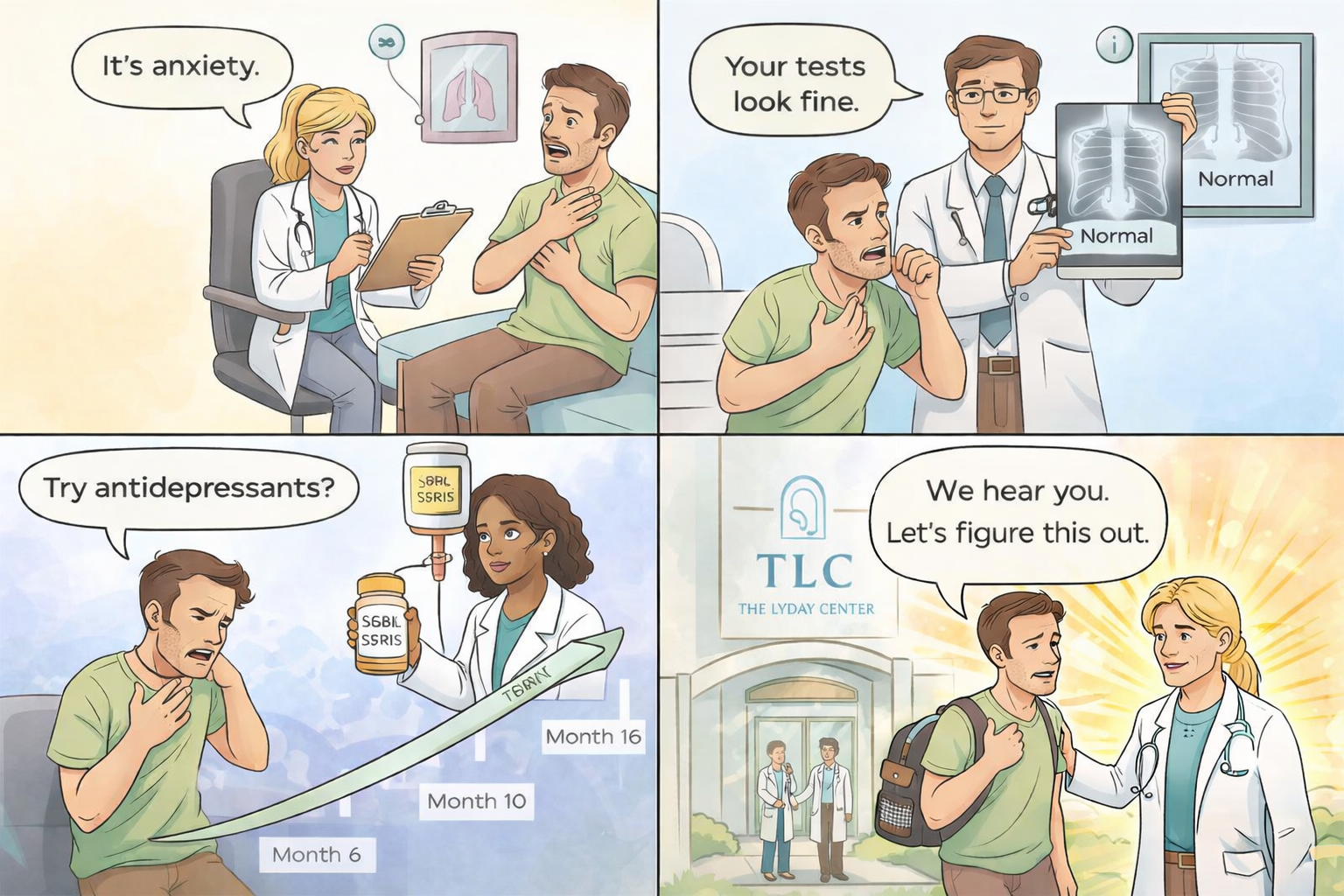
When Medicine Gaslights the Sick: Why So Many Mold-Injured Patients Are Told “It’s All in Your Head”
One of the most devastating parts of chronic illness isn’t just the physical suffering.
It’s the moment you realize the medical system you trusted no longer believes you.
We see it every week at TLC – The Lyday Center.
Patients come to us after months—or years—of appointments, tests, referrals, imaging, and medications, only to be told some version of:
“Your labs are normal.”
“Your scans don’t explain your symptoms.”
“It’s probably anxiety.”
“Have you considered an antidepressant?”
This is medical gaslighting.
And it is especially common in mold-related illness.
A Story We See Over and Over (Details Changed for Privacy)
A young adult came to us recently after nearly a year of progressive symptoms affecting his breathing, chest, muscles, nerves, fatigue, and overall quality of life.
He had never been chronically ill before.
His symptoms began after a clear environmental exposure—one involving water damage, trapped moisture, and ongoing contact with a contaminated HVAC system at work. The exposure was real. The timeline was clear. The decline was steady.
Yet despite:
abnormal imaging findings,
persistent shortness of breath,
chest pain,
neurological symptoms,
overwhelming fatigue,
and worsening functional capacity,
he was repeatedly told:
“Your oxygen is fine.”
“Your pulmonary tests are normal.”
“Steroids didn’t help, so there’s nothing else to do.”
“This is anxiety.”
Because he had a prior history of panic attacks years earlier, everything happening to his body was filtered through that lens.
This is one of the most painful truths in medicine:
Once anxiety or depression appears in your chart, many clinicians stop looking for physical causes.
Why Mold Patients Are Especially Vulnerable to Gaslighting
Mold-related illness does not behave like classic textbook disease.
Inflammation can be localized, intermittent, or shifting
Standard labs may appear “normal”
Imaging findings may be subtle or dismissed
Symptoms affect multiple systems at once
Patients often look okay while feeling profoundly unwell
And because mold illness can involve the nervous system, patients may develop:
anxiety
sleep disturbance
cognitive changes
panic sensations
These are secondary effects, not the cause.
But in allopathic medicine, the presence of psychiatric symptoms often becomes the end of the diagnostic process instead of the beginning.
“If You’re Not Dying Today, There’s No Urgency”
Many patients tell us this is how care begins to feel.
Appointments stretch months apart.
Referrals lead nowhere.
There is no plan, no roadmap, no explanation.
The message becomes:
“You’re not sick enough to matter.”
That erosion of hope is often more damaging than the illness itself.
What We Do Differently at TLC
At The Lyday Center, we start from a different premise:
Your symptoms are real.
Your story matters.
And there is always a reason.
We don’t ask, “Is this anxiety or physical?”
We ask, “What happened to your body?”
We look at:
environmental exposure history
immune activation
inflammatory patterns
autonomic dysfunction
toxin burden
infectious triggers
nervous system overload
We connect timelines.
We respect pattern recognition.
We listen—fully.
Root cause medicine is not fast medicine.
But it is honest medicine.
Hope Matters — And So Does Persistence
This patient didn’t come to us because he wanted another label.
He came because he wanted answers.
And while healing is a process—not a single appointment—we believe something profoundly important:
No one should be told to live with suffering simply because conventional testing hasn’t caught up yet.
At TLC, we walk with our patients step by step, even when the road is long. Especially when the road is long.
If You’ve Been Told “It’s All in Your Head”
Please hear this clearly:
You are not weak.
You are not imagining this.
And you are not alone.
There is a difference between reassurance and dismissal.
There is a difference between anxiety causing symptoms and illness creating anxiety.
At TLC – The Lyday Center, we are committed to finding that difference—because root cause diagnosis is the only path to true healing.
And we will not stop listening until the story finally makes sense.