
I Refuse To Accept “There’s Nothing Left To Do…”
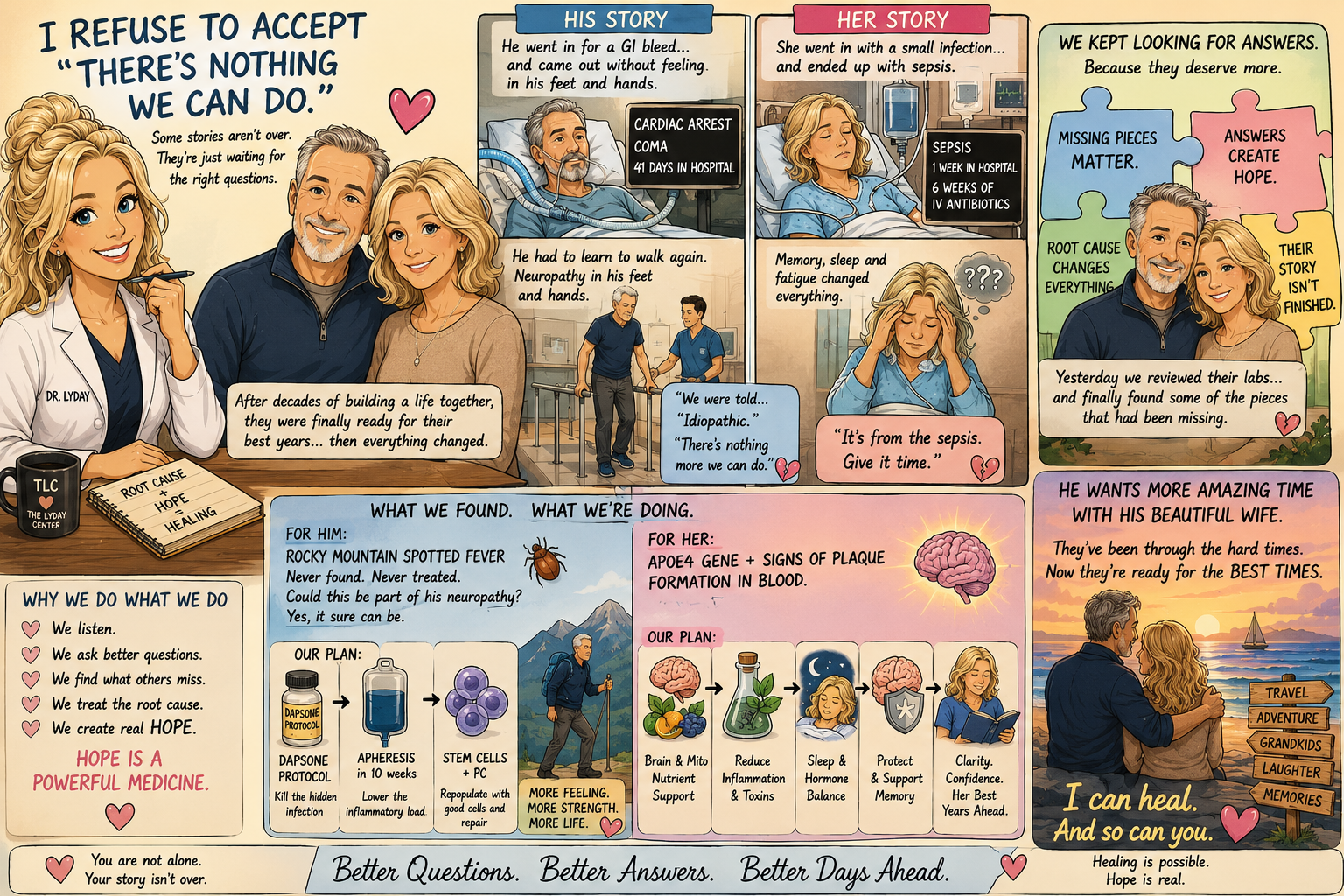
Sometimes the greatest act of hope is asking one more question.
This week, I sat across from a husband and wife whose stories broke my heart.
Not because of what they had lost.
But because of what they had been told.
"It's idiopathic."
"It's probably just from the hospitalization."
"You're getting older."
"There's really nothing more we can do."
I don't accept that answer.
Not for them.
Not for any patient who walks through my door.
(Details have been changed to protect this family's privacy, but the story—and the hope—is very real.)
They Were Finally Supposed to Be Living Their Best Years
After decades of building careers...
Raising a family...
Weathering life's storms...
They had finally reached the chapter everyone dreams about.
Retirement wasn't just around the corner.
It was here.
Time to travel.
Time together.
Time with grandchildren.
Time to simply enjoy the life they had spent decades creating.
Instead...
Life had other plans.
His Story
Years ago, he walked into the hospital with a gastrointestinal bleed.
A terrifying event, yes.
But something he expected to recover from.
Instead, his hospitalization became a cascade of complications, including cardiac arrests, a prolonged ICU stay, and rehabilitation. When he finally came home, he had lost much of the feeling in his hands and feet and had to relearn how to walk.
The explanation?
"Sometimes this just happens."
"It's idiopathic neuropathy."
"Learn to live with it."
But what if that wasn't the whole story?
Her Story
She had always been healthy.
Then a seemingly routine infection spiraled into sepsis.
She survived.
But something stayed behind.
The woman who came home wasn't quite the same woman who had gone into the hospital.
Her memory changed.
Sleep changed.
Fatigue became a constant companion.
Brain imaging looked reassuring.
Specialists told her it was probably the after-effects of sepsis and that time might help.
So they waited.
And waited.
Yesterday...
They came back to review their laboratory results.
Not because I promised miracles.
Because I promised we would keep asking questions.
And suddenly...
Pieces that had never been put together before began to fit.
For Him...
One of his specialized infectious disease tests suggested exposure to Rocky Mountain spotted fever, an infection that can affect the nervous system and, in some people, has been associated with long-term neurologic complications if diagnosis or treatment is delayed. While we cannot say this definitively explains all of his neuropathy, it is a biologically plausible contributor that deserves attention rather than dismissal.
Instead of simply accepting "idiopathic neuropathy," we now have another lead to investigate.
Our plan is aggressive but thoughtful.
First...
Reduce the infectious burden.
Then...
Reduce inflammation.
Then...
Help create an environment where healing is more likely.
For him, that means beginning our dapsone-based protocol and, if appropriate, following it with therapeutic plasma exchange to reduce inflammatory mediators before regenerative therapies such as phosphatidylcholine and stem-cell–based treatments are considered as part of his broader care plan.
Because healing doesn't happen in a vacuum.
Sometimes you have to quiet the storm before rebuilding the house.
For Her...
Her laboratory evaluation raised another important question.
She carries one copy of the ApoE4 gene variant, which is associated with an increased lifetime risk of Alzheimer's disease but is not a diagnosis.
Even more importantly...
Her blood work also showed biomarkers that may be consistent with increased amyloid plaque formation and neurodegeneration risk. These tests are still relatively new and are intended to be interpreted alongside the patient's symptoms and clinical evaluation—they do not, by themselves, diagnose Alzheimer's disease.
That's exactly why we wanted to know.
Not so we could scare her.
So we could act.
Because prevention is infinitely more powerful than waiting.
Instead of saying,
"Let's see what happens..."
We're asking,
"How do we reduce inflammation? Optimize sleep? Improve metabolic health? Support brain health? Address toxic exposures? Treat underlying contributors?"
Those are questions worth asking.
The Best Part of Yesterday
It wasn't the lab results.
It wasn't the treatment plan.
It wasn't the science.
It was watching him look at his wife.
After everything they've endured...
After years of uncertainty...
After being told over and over again that there wasn't much left to do...
He smiled.
And he said he wanted more amazing years with his beautiful wife.
Not just more years.
Amazing years.
That is why I love what I do.
Not because I think I have all the answers.
But because I refuse to stop looking for them.
Hope Is a Medical Intervention
Functional medicine isn't about pretending every illness has an easy fix.
It doesn't.
Some diseases leave permanent scars.
Some injuries can't be completely reversed.
But that doesn't mean we stop asking better questions.
Sometimes we find an infection that was never recognized.
Sometimes we uncover nutritional deficiencies, inflammation, toxic exposures, or metabolic dysfunction that can be addressed.
Sometimes we improve quality of life, even when we can't erase everything that happened.
And sometimes...
Hope itself becomes the beginning of healing.
To Anyone Reading This...
If you've ever been told:
"Your labs are normal."
"It's just aging."
"You'll have to learn to live with it."
Don't lose your curiosity.
Keep asking questions.
Keep searching for answers.
Keep believing your story isn't finished.
Because healing isn't always about going back to who you were.
Sometimes...
It's about discovering who you can still become.
❤️ I can heal.
And maybe...
So can you.