
When The Air Outside Becomes The Enemy…
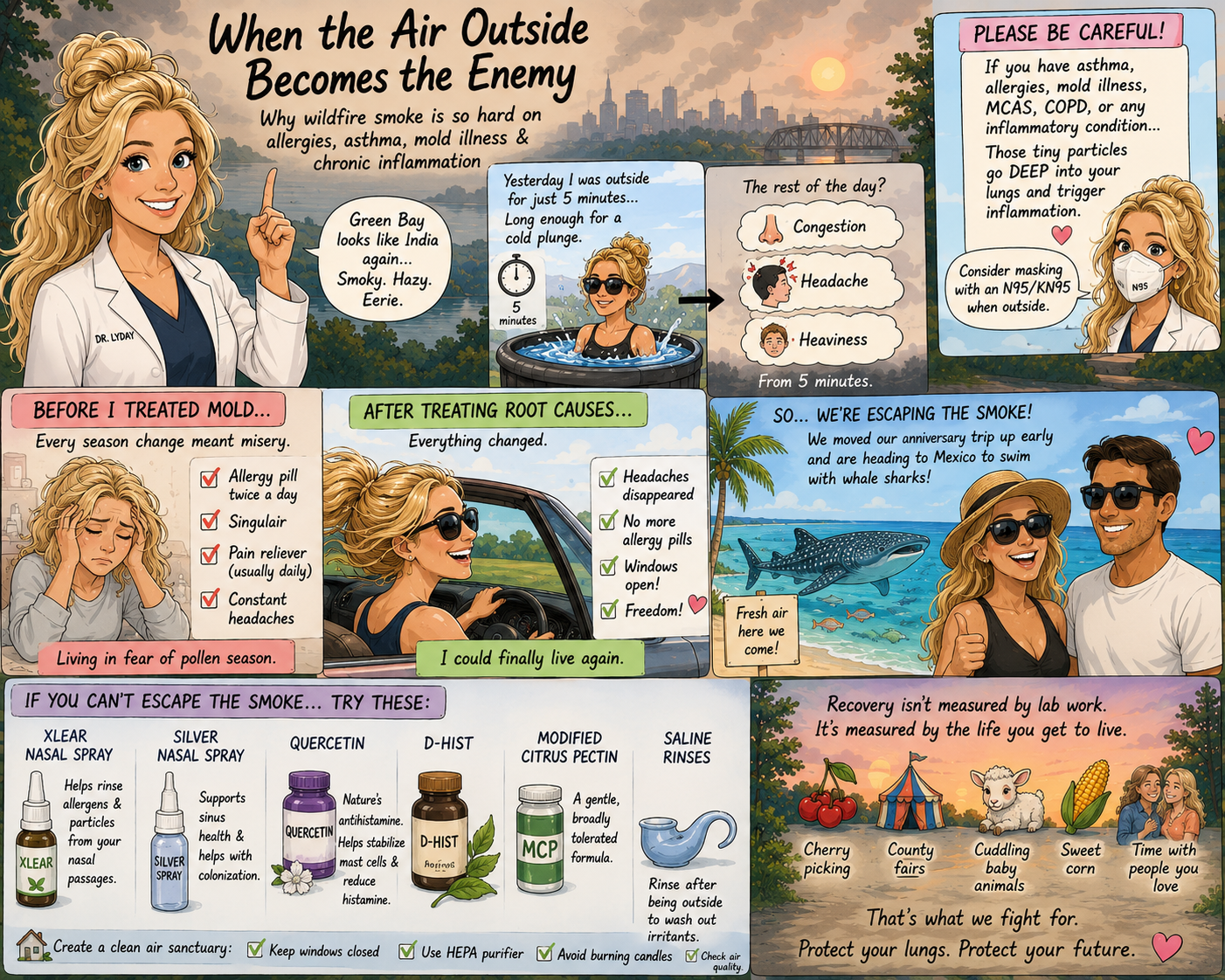
Why Wildfire Smoke Feels So Different When You Have Allergies, Asthma, Mold Illness, or Chronic Inflammation
Yesterday I was outside for...
Five minutes.
That's it.
Just long enough to jump into my cold plunge.
Five minutes.
The rest of the day?
Congestion.
Headache.
Brain fog.
That heavy, inflamed feeling I haven't experienced in a long time.
Five minutes.
If you're wondering whether the smoke blanketing Green Bay right now is affecting you...
The answer is probably yes.
It Looks Like India Again
As I looked out my window this morning, I couldn't help but think back to the incredible trips my mom and I took around the world.
India was one of the most beautiful places I've ever visited.
But there were days when the air was so thick with pollution that the sun became little more than a glowing orange circle behind the haze.
That's exactly what Green Bay looks like right now.
Sunny...
Sort of.
Except you can't really see the sun.
It's eerie.
The smoke from the Canadian wildfires has settled over Wisconsin, and health officials are recommending people limit time outdoors because the fine particulate matter (PM2.5) can reach unhealthy or even hazardous levels depending on conditions. These tiny particles are small enough to penetrate deep into the lungs and can worsen asthma, allergies, heart disease, and other chronic health conditions. (AP News)
This Took Me Back...
Before I discovered mold illness...
Before I became "Patient Zero."
Back when I was trying to survive every allergy season.
I was taking:
💊 Allergy medication twice a day.
💊 Singulair.
💊 Pain medication—usually every day—for relentless headaches.
Every season change meant one thing.
Another pounding headache.
Another sinus flare.
Another miserable few weeks.
Then something incredible happened.
When I started treating the root causes of my inflammation—using binders, targeted nasal therapies, reducing my mold exposure, and calming my immune system—
My headaches disappeared.
My allergy medications slowly disappeared.
I could roll the windows down in my car without immediately regretting it.
I could open the windows in my house.
I wasn't living in fear of pollen season anymore.
That freedom was priceless.
Why This Smoke Hits Some People So Hard
Not everyone's body responds the same way.
If your lungs are already inflamed...
If you have asthma...
Seasonal allergies...
Mold illness...
Long COVID...
MCAS...
COPD...
Or any chronic inflammatory condition...
Your body is already working overtime.
Now imagine asking those already-inflamed lungs to filter microscopic smoke particles all day.
That's exactly what's happening.
Those particles don't just irritate the nose.
They can reach deep into the lungs and trigger inflammation throughout the body. (AP News)
Please Be Careful
Over the last several days I've watched people:
🚴 Ride bikes.
🏃 Go for long runs.
🚜 Work outside for hours.
🚶 Exercise like nothing is happening.
If you're young and healthy...
Your body will probably tolerate it.
If you're one of my warriors...
I'd think twice.
This isn't the weekend to prove how tough you are.
If your lungs are your weak spot...
Protect them.
If you absolutely have to be outside for an extended period during periods of poor air quality, consider wearing a well-fitting N95 or KN95 respirator, which can reduce inhalation of fine particulate matter much more effectively than cloth or standard surgical masks. Public health agencies also recommend limiting strenuous outdoor activity, keeping windows closed when smoke is heavy, and using indoor air filtration if available. (AP News)
The Good News?
Gio and I are cheating.
We had originally planned to leave next Wednesday for our first anniversary trip.
We're heading to Mexico to swim with whale sharks.
But after seeing this forecast...
We moved the trip up.
Fresh ocean air sounds pretty amazing right now.
If You Can't Escape the Smoke...
Here are a few things I commonly recommend to patients during heavy allergy and smoke seasons. These aren't a substitute for medical care, but they may help reduce the inflammatory burden.
🌿 Xlear Nasal Spray
A saline and xylitol nasal spray can help rinse allergens and particulate matter from the nasal passages.
🩶 Silver Nasal Spray
Some patients find silver nasal sprays helpful as part of their overall sinus hygiene routine. While not as targeted as prescription therapies I use in certain patients, they may help support the nasal environment during periods of increased exposure.
🌼 Quercetin
Often called "nature's antihistamine," quercetin may help stabilize mast cells and reduce histamine release in some individuals.
🌱 D-Hist
One of my favorite natural allergy support formulas, containing ingredients such as quercetin and stinging nettle, that many patients find helpful during allergy season.
🍊 Modified Citrus Pectin
If you're looking for a gentle, broadly tolerated binder, modified citrus pectin is one I often recommend. While it won't stop the smoke, it may be a reasonable option as part of a broader plan for certain patients.
💧 Saline Rinses
A simple saline rinse after spending time outdoors can help remove smoke particles, pollen, and other irritants before they continue triggering inflammation.
🏠 Create a "Clean Air Sanctuary"
Keep windows closed during heavy smoke.
Use a HEPA air purifier if you have one.
Avoid burning candles or using wood-burning fireplaces while outdoor air quality is poor.
Check your local air quality before planning outdoor activities.
Remember...
Your body only has so much capacity.
Every exposure fills the bucket a little more.
Sometimes it's pollen.
Sometimes it's mold.
Sometimes it's wildfire smoke.
Sometimes it's all three at once.
The goal isn't to live in fear.
The goal is to reduce the total burden so your immune system can stop fighting and start healing.
Take care of those lungs.
You'll need them for the adventures ahead.
And if you happen to see one very happy Wisconsin doctor and her hubby floating in the crystal-clear waters of Mexico this week...
You'll know exactly why we left a few days early. 🌴🐋✈️