
It’s JUST A RASH…
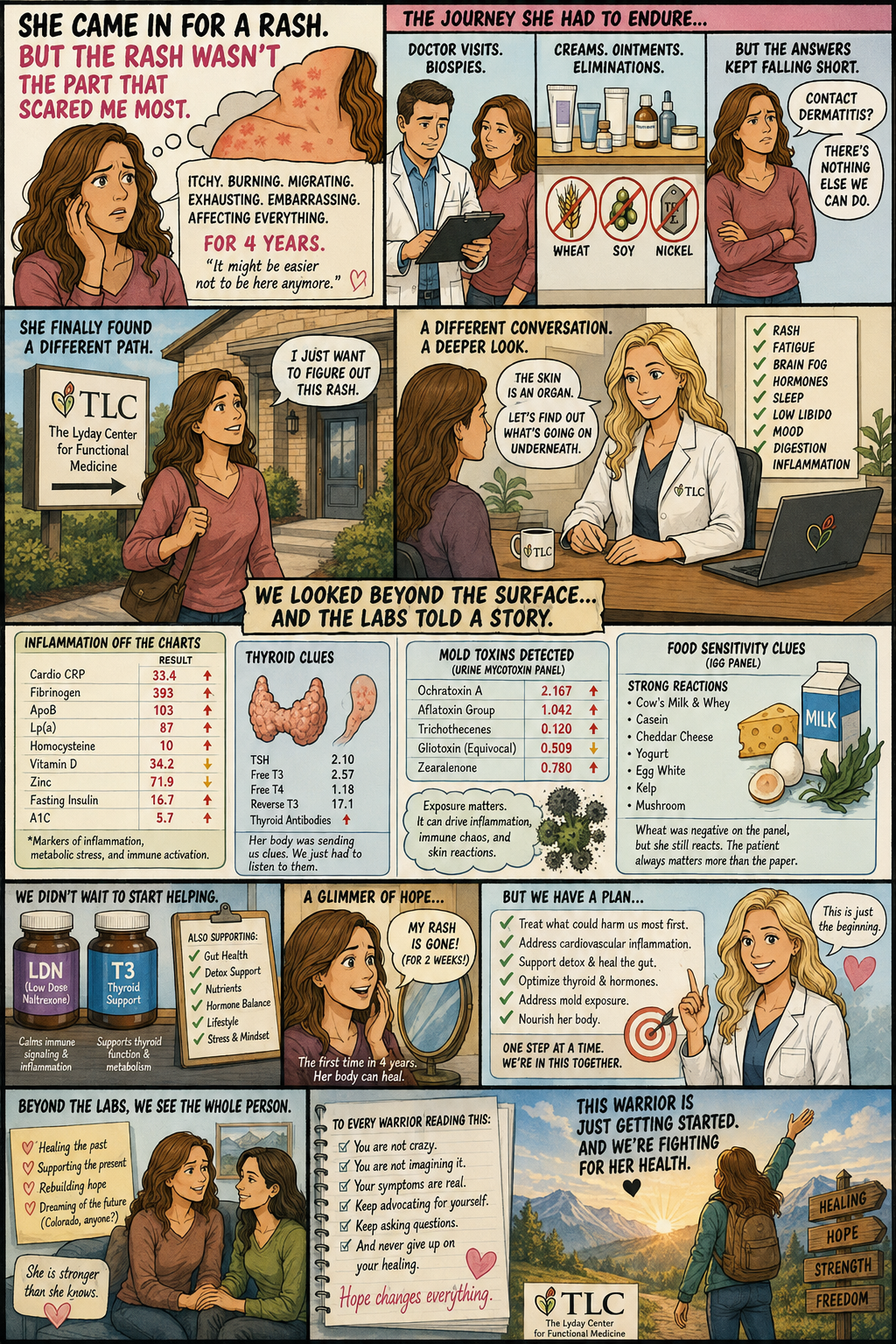
Rash, inflammatory markers, mold, hsCRP
SHE CAME IN FOR A RASH.
But the rash wasn't the part that scared me most.
Sometimes a patient comes into my office with a symptom everyone else has already decided isn't very interesting.
A rash.
She had seen primary care.
Dermatology.
Rheumatology.
Biopsies had been done.
Products had been changed.
Foods had been eliminated.
Ointments had been prescribed.
The answer kept circling back to some version of:
Contact dermatitis.
Except there was one problem.
She wasn't getting better.
For nearly four years, this rash had been appearing, disappearing, moving and returning.
Groin.
Legs.
Shoulders.
Around her ears.
It burned.
It itched.
Sometimes it would stay for a week and then appear somewhere else.
And eventually, it wasn't just affecting her skin.
It was taking over her life.
"Nobody seems worried about this."
She was exhausted.
Her brain felt foggy.
Her energy was disappearing.
Sleep was becoming a mess.
Her libido had changed.
When the rash flared, she felt sick.
She didn't want to be touched.
She didn't feel comfortable in her own skin.
It was affecting her relationship.
And she had reached a point where the relentless itching, burning, exhaustion and frustration had become so overwhelming that she had thoughts that it might be easier not to be here anymore.
That sentence matters.
A lot.
When chronic illness reaches the point that someone is losing hope or having thoughts of not wanting to be alive, that requires immediate attention and appropriate mental-health/safety support—not simply another cream and another appointment six months from now.
She had support. She had been working with a therapist.
But she also desperately wanted someone to investigate what was happening physically.
She was crying when she talked about it.
Her goal wasn't complicated:
"I just want to figure out this rash."
And I believed her.
The Skin Is an Organ
Here's something I wish more chronically ill patients heard:
A rash is not automatically "just a skin problem."
Skin can reflect allergy, contact exposure, infection, medication reactions, autoimmune disease, metabolic dysfunction, hormonal changes and systemic inflammation.
Sometimes dermatology is the answer.
Sometimes the biopsy gives us exactly what we need.
And sometimes a pathology label describes what the skin looks like without explaining why this particular human being keeps developing it.
Her biopsies mattered.
But after years of symptoms, fatigue, brain fog and a migrating inflammatory rash, I wanted to ask another question:
What is happening underneath the skin?
So We Went Looking
And here's the part I want patients to understand:
A lot of the first investigation wasn't exotic.
It wasn't a $10,000 test available only through some secret functional-medicine laboratory.
We drew many of the inflammatory, metabolic, nutritional and immune markers through a local laboratory.
You just have to know what you're looking for.
And when her results came back?
Holy inflammation, Batman.
Her high-sensitivity CRP was 33.4.
For context, hs-CRP is a nonspecific marker. It cannot tell us why someone is inflamed, and values above 10 mg/L should generally prompt consideration of acute infection or another inflammatory process and often repeat testing when clinically appropriate.
But 33.4 was not something I was going to ignore.
Her fibrinogen was also elevated at 393, and ApoB was 103.
Then we got deeper into the inflammatory signaling pathways.
Her TGF-beta 1 was 36,660, compared with the laboratory/clinical target listed in her report of less than 2,380.
Her MSH was only 0.7, with the reference range listed as 35–81.
VEGF was 27, below the laboratory reference interval listed in her results.
Now we had a very different conversation.
Because regardless of what ultimately caused every abnormal marker:
This woman was not imagining that something was happening in her body.
Her immune/inflammatory system deserved investigation.
And There Were More Breadcrumbs
Her thyroid story caught my attention too.
Her TSH was 2.10, reverse T3 was 17.1, free T3 was 2.57 and free T4 was 1.18.
She also had measurable thyroid antibodies reported in the panel.
Vitamin D was only 34.2. Zinc was 71.9.
Fasting insulin was 16.7 and hemoglobin A1c 5.7, giving us another metabolic piece to work on.
Was any ONE of those numbers "the cause of the rash?"
No.
That's not how I look at complicated patients.
I was looking at the terrain.
Immune signaling.
Inflammation.
Hormones.
Metabolism.
Nutrients.
Gut.
Environment.
And then asking which pieces were modifiable.
We Didn't Wait to Start Helping
While we waited for the rest of her investigation, I started two things based on her individual clinical picture.
Low-dose naltrexone (LDN) as an off-label strategy intended to help modulate inflammatory signaling.
And a cautious trial of T3 thyroid hormone, given her thyroid pattern and symptoms.
Neither was prescribed as a magical "rash cure."
We were trying to start correcting pieces of the physiology while continuing to search for the drivers.
And then she came back.
"The Rash Went Away."
At follow-up, she told me:
Her rash had completely disappeared for about two weeks.
It subsequently began to flare again, but overall it was substantially better. Her follow-up documentation confirms that improvement.
She would occasionally feel like it was trying to come back.
But something had changed.
After FOUR YEARS of chasing this thing...
her skin had finally gone quiet for a while.
Now, does that prove LDN or T3 cured her rash?
Absolutely not.
Multiple things were changing simultaneously, and chronic inflammatory skin conditions naturally wax and wane.
But it told me something incredibly important:
Her physiology wasn't stuck forever.
Her body could change.
So we kept looking.
Then We Found Mold Metabolites
Her urine mycotoxin panel reported several detectable/present compounds.
Ochratoxin A was reported present at 2.167 ppb.
The aflatoxin group was present at 1.042.
Macrocyclic trichothecenes were present at 0.120.
Zearalenone was present at 0.780.
Gliotoxin derivative was reported equivocal at 0.509.
Interestingly, the laboratory's own educational material lists dermatitis among reported associations with ochratoxin A and includes rashes and hives among symptoms associated with mycotoxin exposure.
That does not prove mold caused her rash.
Urinary mycotoxin testing has important limitations, and detecting a mycotoxin does not establish where exposure occurred, when it occurred, or that it caused a particular symptom.
But in the context of her history and inflammatory findings?
It was another breadcrumb worth investigating.
So now we're also looking at her environment.
Her Food Testing Was Interesting Too
For years she had already worked incredibly hard to identify foods that seemed to aggravate her symptoms.
Her IgG panel showed its strongest reported reactions to cow's milk and whey, with moderate reactions to casein, cheddar cheese, yogurt, egg white, kelp and mushroom.
Interestingly, wheat—the food she had clinically associated with itching—was Class 0 on this particular IgG panel.
That is actually a beautiful reminder:
The patient is more important than the paper.
Food-specific IgG testing does not diagnose IgE-mediated food allergy and remains controversial as a diagnostic tool for food intolerance.
So I'm not going to tell someone:
"Congratulations! Your paper says wheat is fine. Go eat it."
when she repeatedly tells me her body reacts to it.
Labs are clues.
They aren't the patient.
But Then We Had to Decide What Came First
This is one of the hardest parts of functional medicine.
Once you start looking deeply enough, you can find a lot to work on.
Mold.
Gut.
Hormones.
Nutrients.
Metabolism.
Inflammation.
Food.
Thyroid.
But patients cannot do 47 things simultaneously.
And I have a rule:
WE DEAL WITH WHAT HAS THE POTENTIAL TO HURT US MOST FIRST.
Her cardiovascular inflammatory picture got my attention.
Her hs-CRP was 33.4.
Fibrinogen was elevated.
ApoB was elevated.
Lp(a) was 87.
And there was family cardiovascular history in the background.
Those markers do not prove "spike protein" is causing cardiovascular inflammation. There currently is not a routine clinical blood test that can establish persistent spike protein as the cause of abnormalities such as CRP, fibrinogen, ApoB or Lp(a).
So before attributing those findings to any one mechanism, conventional cardiovascular risk assessment and evaluation for other causes of marked inflammation matter too.
But clinically, the message was crystal clear:
Her inflammatory and cardiovascular risk picture deserved attention NOW.
The rash matters tremendously.
But first, we protect the human wearing the skin.
This Is Why Medical Gaslighting Is So Damaging
I don't use the term "medical gaslighting" every time doctors disagree.
Medicine is difficult.
Doctors don't always know.
Tests aren't perfect.
Symptoms overlap.
And sometimes the correct answer truly is:
"I don't know yet."
There is nothing wrong with saying that.
The problem begins when:
"I don't know what's causing this" becomes "there's nothing wrong with you."
Those are two VERY different sentences.
This woman knew something was wrong.
She wasn't being dramatic.
She wasn't obsessing over a little rash.
She wasn't failing to cope.
She had been living inside a body that itched, burned, exhausted her and disrupted her life for years.
And when we finally looked beyond the surface?
There were objective abnormalities worth investigating.
Imagine What It Felt Like to See 33.4
Sometimes abnormal laboratory results scare patients.
Sometimes they do something completely different.
They give them relief.
Not because anyone wants abnormal labs.
But because after years of:
"Your biopsy just says dermatitis."
"Try another cream."
"Everything looks okay."
someone finally puts a piece of paper in front of you and says:
"I see it too."
I cannot tell you how powerful that moment can be.
This Warrior's Story Isn't Finished
Her rash is already dramatically different.
Now we're working through the next layers.
We're addressing her cardiovascular and systemic inflammatory risk.
We're supporting nutrients that need attention.
We're investigating her environmental exposure.
We're looking at her home.
We're continuing to work on thyroid, metabolism, gut and immune regulation.
And we're going to follow the numbers instead of guessing.
Will every abnormality explain the rash?
Probably not.
Will every intervention work?
Probably not.
That's medicine.
But she finally has something she desperately needed:
A direction.
And to every person reading this who has been told:
"Your tests are normal."
"It's just dermatitis."
"You're probably stressed."
"There's nothing else to do."
I want you to understand an important distinction.
Sometimes your doctors have appropriately ruled out dangerous diseases—and that's valuable.
Sometimes the answer really isn't obvious.
But not knowing the answer does not make your suffering imaginary.
Keep advocating for yourself.
Ask what else belongs on the differential.
Ask whether your symptoms have changed enough to warrant reevaluation.
And if your physical illness has beaten you down to the point that you are thinking you would rather not be here, tell someone immediately. In the U.S., you can call or text 988 for immediate crisis support. Those thoughts deserve treatment with the same urgency as any other potentially life-threatening symptom.
This warrior almost lost hope over "a rash."
I'm really glad she didn't.
Because sometimes the thing everyone else has stopped worrying about...
is exactly where the next chapter begins.
❤️
To be continued.
Details have been removed or generalized to protect patient privacy. Case stories are educational and do not establish that a particular laboratory abnormality caused a patient's symptoms or that a particular treatment produced improvement. Individual results require clinical interpretation. LDN is used off-label for many inflammatory conditions; thyroid hormone requires individualized prescribing and monitoring. Markedly elevated inflammatory markers warrant appropriate medical evaluation for infectious, autoimmune, cardiovascular and other causes.