
Lipidema: When It’s Not “Just Weight”
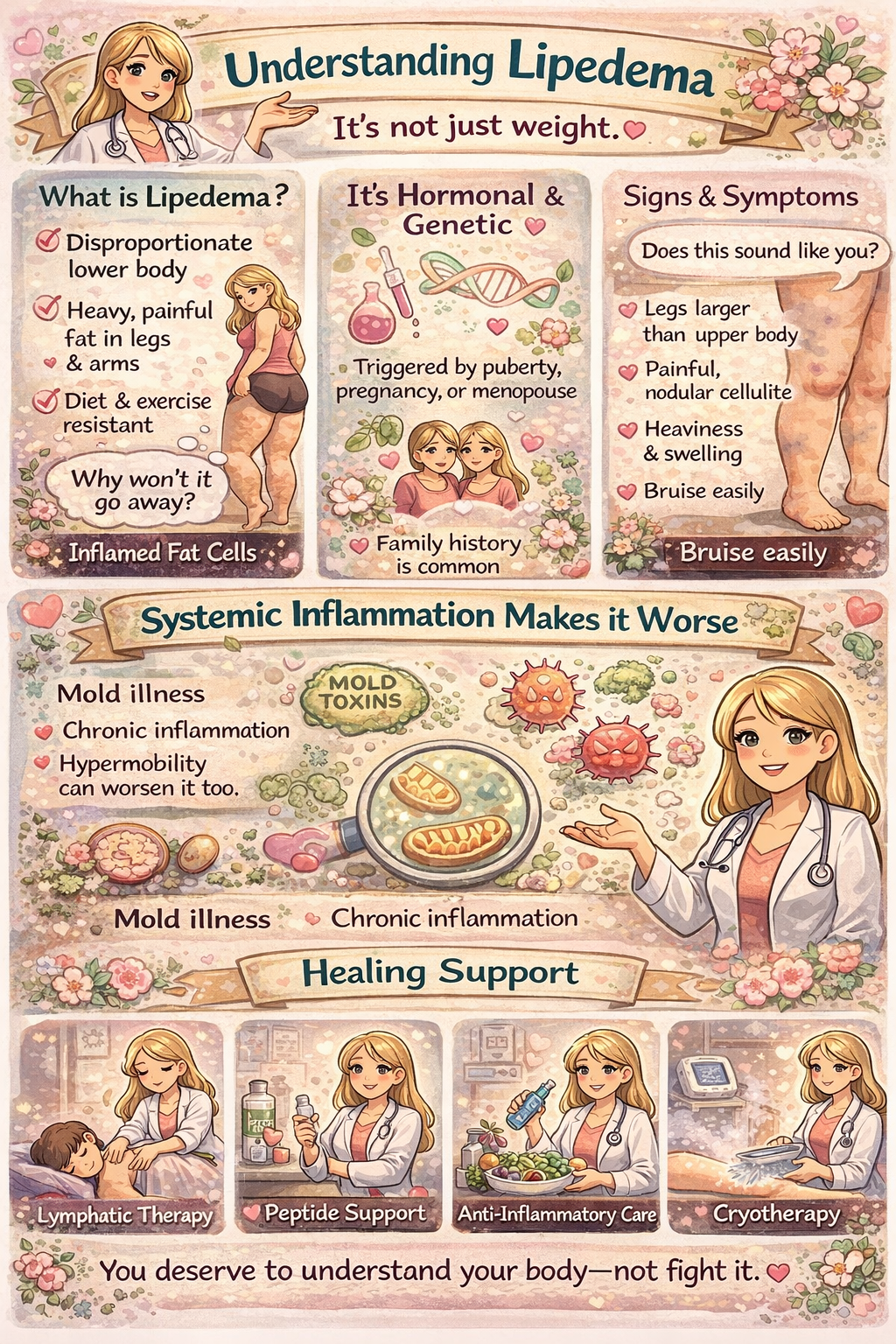
Lipedema: When It’s Not “Just Weight”
For years, I thought I just had “thick legs.”
Even when I lost weight.
Even when I exercised.
Even when I was at my leanest in medical school.
My upper body would slim down.
My waist would shrink.
But my legs remained disproportionately heavy — with painful, nodular cellulite that never responded the way the rest of my body did.
It wasn’t laziness.
It wasn’t lack of discipline.
It wasn’t “just genetics.”
It was lipedema.
What Is Lipedema?
Lipedema is a chronic fat distribution disorder that primarily affects women. It is characterized by:
Symmetrical enlargement of the legs (and sometimes arms)
Disproportion between upper and lower body
Painful, tender fat tissue
Easy bruising
A “cuffing” effect at the ankles or wrists
Resistance to traditional diet and exercise
It is often mistaken for obesity or simple cellulite.
But lipedema fat behaves differently.
It is hormonally influenced.
It is inflammatory.
And it does not respond normally to caloric restriction.
What Does Lipedema Look Like?
Common features include:
Lean torso with larger hips and thighs
Soft, nodular tissue under the skin
Heavy, aching legs
Swelling that worsens throughout the day
Sensitivity to touch
Difficulty losing fat from the lower body
Many women describe feeling like their legs don’t belong to the rest of their body.
If that sounds familiar — you are not alone.
Is It Genetic?
Yes — there is often a family history.
Hormonal shifts (puberty, pregnancy, perimenopause) frequently trigger progression.
But genetics are only part of the story.
Inflammation matters too.
How Inflammation — Including Mold Exposure — May Make It Worse
While lipedema is not caused by mold, systemic inflammation can absolutely worsen symptoms.
When I experienced significant mold exposure more than seven years ago, something changed.
The weight that I had worked so hard to lose began to return.
My exercise tolerance dropped.
My legs became more painful.
Walking felt heavier.
And inflammation felt constant.
Mold illness creates:
Immune activation
Cytokine release
Mitochondrial stress
Hormonal dysregulation
Fluid retention
In someone with lipedema and hypermobility genetics, this can create the perfect storm.
Inflamed tissue retains more fluid.
Mitochondria underperform.
Pain increases.
Movement decreases.
And the cycle continues.
My Turning Point
On our recent trip, I decided to focus intentionally on healing.
Instead of pushing harder, I supported my physiology.
Over three weeks we focused on:
Gradually increasing daily movement
Working up to over 15,000 steps per day
Peptide support for mitochondrial function
Multiple therapeutic massages
Manual lymphatic and fluid return support
Nervous system regulation
Anti-inflammatory nutrition
The result?
Reduced pain.
Improved endurance.
Better fluid movement.
More resilience.
Not perfection.
But progress.
Who Treats Lipedema?
There is no single “cure,” but management can include:
Functional medicine to reduce inflammation
Lymphatic therapy
Manual lymphatic drainage
Compression therapy
Anti-inflammatory nutrition
Hormone balancing when appropriate
Mitochondrial support
Targeted exercise (low-impact resistance and walking)
In some cases, specialized lipedema liposuction is considered — but only after foundational inflammation is addressed.
New Modalities and Targeted Support
We are also bringing new body-contouring modalities to the clinic, including CryoSlim technology, which may help support targeted fat reduction and tissue remodeling in appropriate candidates.
These tools are not a replacement for metabolic healing — but they can be supportive when layered into a comprehensive strategy.
If You Think You Might Have Lipedema
Ask yourself:
Are my legs disproportionately larger than my torso?
Do they bruise easily?
Are they painful to pressure?
Does weight loss not change their shape significantly?
Does inflammation make them worse?
If yes, it’s worth exploring.
The Bigger Picture
Lipedema is not a failure of willpower.
It is a complex interplay of:
Genetics
Hormones
Connective tissue integrity
Inflammation
Mitochondrial health
Lymphatic flow
Add mold exposure and hypermobility into the mix, and the terrain becomes even more reactive.
But reactive does not mean hopeless.
It means strategic.
If you would like to:
Reduce systemic inflammation
Improve lymphatic flow
Support mitochondrial function
Address mold-related immune activation
Build a personalized lipedema support plan
Schedule a visit.
You deserve to understand your body — not fight it.
With compassion and strategy,
Dr. Tamara Lyday
The Lyday Center